On this page
Cold joints don’t like surprises, and that’s my disputed premise for senior walks: the walk doesn’t start at the front door, it starts in the living room five minutes earlier. From a whole-patient view, stiffness in an older dog is both Western mechanics — thicker synovial fluid, slower muscle firing — and Eastern pattern — cold and stagnation settling in the channels overnight. You loosen both the same way, with gentle heat, movement, and hands-on contact braided together.
I learned how much those five minutes matter with a 12-year-old yellow Lab who lived with his retired owner in a ranch house outside Columbus. He’d sleep on tile until 7 a.m., then try to launch straight down three porch steps for his morning pee. For 11 straight mornings the owner timed it: 40 to 50 seconds of pottering, head low, right hind skipping before he found his rhythm. We moved the start inside instead of at the curb, with rug marching and sit-to-stands before the leash ever came out. By February 12, day nine of the new sequence, that same first 30 yards took a steady shuffle with no skip, and he was sniffing instead of bracing.
Why older joints need a runway, not a doorway launch
Think contrast: a young dog warms its own oil by bouncing. An older dog’s oil is cold honey. Gentle indoor motion thins joint fluid, wakes the hind-end muscles that atrophy first, and tells the nervous system it’s safe to stride out.
VCA Hospitals describes how arthritis in dogs shows up as stiffness after rest, lagging on walks, and trouble with stairs — exactly the signs a warm-up is meant to soften before you ask for distance.
Food therapy, Tui-na bodywork, acupuncture principles, and herbs all point the same way here: support circulation first, then load. That also frames where oral joint support fits. Glucosamine and chondroitin are among the most studied joint support ingredients for dogs, but they work in the background to support normal cartilage and joint structure, they don’t replace the warm-up itself. For a fuller label-reading walkthrough, see my notes on Dog Hip and Joint Supplements: What Actually Helps and What’s Just Marketing.
That background matters because movement helps maintain healthy synovial fluid homeostasis, the easy glide inside the joint capsule. Research on turmeric fractions discussed by Frontiers in Veterinary Science looked at joint tissues in osteoarthritic dogs, which reminds you why we pair steady motion with long-game nutrition rather than expecting one walk to fix stiffness.
The 5-minute indoor sequence I use
You’ll need a rug or yoga mat, good footing, treats, and your hands. No gear to buy.
Wake the nose and the spine
Start with 60 seconds of slow scatter feeding. Toss five or six small treats in a three-foot circle on the rug so your dog turns the neck left, right, and down. Neck turns are Tui-na without the name — they mobilize cervical fascia and get weight shifting through the forelimbs.
Follow with three cookie stretches: lure nose to shoulder on each side, then nose down between the paws. Hold each for a count of five. You’re looking for soft blinking and a sigh, not maximum bend.
Fire the hind end
Now do three to five assisted sit-to-stands, only as deep as your dog offers comfortably. Stand close, hands lightly on hips for guidance, treat on the rise. If squatting is hard, swap in three short weight shifts — lure head side to side while standing so weight rocks through each hind leg.
Finish this block with a 30-second march in place: lure one slow step forward, one back, on the rug. Think tai chi, not treadmill.
Hands-on sweep
Rub palms together until warm, then stroke firmly along both sides of the spine from shoulders to hips, three passes. Then cup each thigh for five seconds, squeeze-release, and glide down to the hock. In TCVM language you’re moving qi and blood through the Bladder and Gallbladder channels along the back and hind leg; in plain language you’re adding warmth and proprioceptive input before cold air hits.
This middle part is where I see owners get fooled. A sturdy 9-year-old cattle-dog mix from a farm outside Ames could do perfect living-room reps, so her owner skipped straight to a half-mile gravel loop. Three evenings in a row she started bright, then faded at about 0.4 miles — head dropping, trot turning to a pace, needing a sit break by the mailbox. We kept the same indoor work but cut the loop to two 10-minute out-and-backs with a sniff rest between, instead of one push. Her fade point moved past the second telephone pole, and she stopped needing that mailbox sit.
Shorter loops exposed the real limit, which was endurance, not willingness.
Take it outside without losing the warmth
Leash up after the indoor work, not before. The first three minutes outside set the tone.
The first block rules
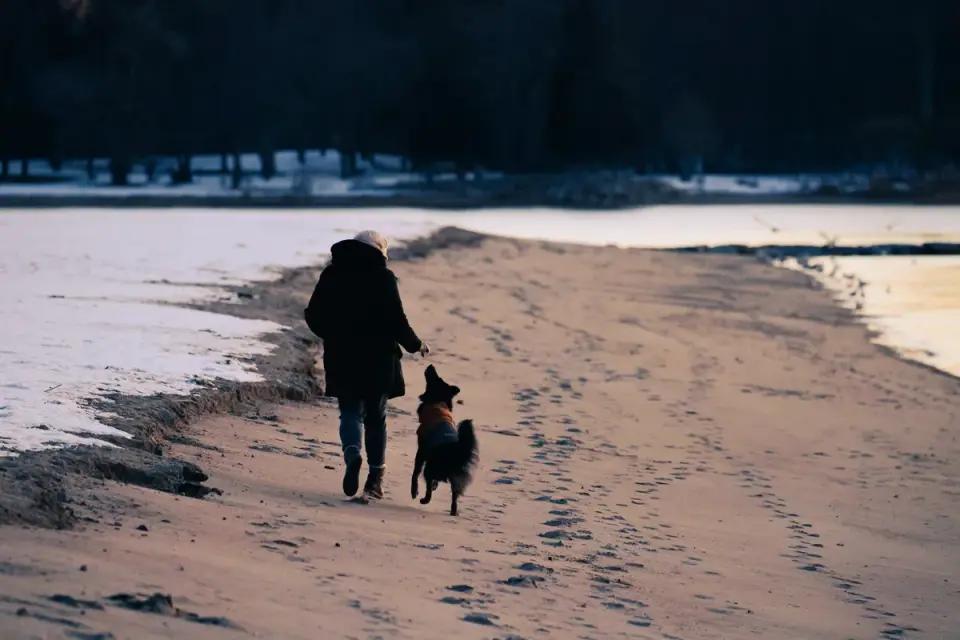
Walk at about half your normal pace for the first 150 to 200 yards. Let sniffing happen — nose-down posture gently stretches the back line. Keep the leash short enough to prevent lunging, long enough to allow a natural head bob.
Avoid the big three cold-start mistakes: sprinting to catch up, ball throws in the first five minutes, and long stair or hill climbs before muscles are warm. Save hills for the middle third when stride is longest.
Read stride, not just speed
Watch for the first 10 to 15 steps: even footfalls, tail at normal carriage, willing turns. Shortened hind stride, bunny-hopping, wide front turns, or sitting down unasked means shorten the walk that day. You’ll get more from 12 good minutes than 25 grinding ones.
The American Kennel Club notes similar early signs — lagging behind, reluctance on stairs, and stiffness after exercise — which is why I log the first-block observations rather than total miles.
When the usual warm-up has to bend
Cold, rain, and flare days change the plan. That’s not failure, it’s pattern recognition. Damp cold tightens tendons faster, so double the indoor portion and halve the outdoor goal.
I think about a 14-year-old, 18-pound terrier mix in a third-floor Chicago walk-up who couldn’t do the standard routine on icy mornings. Two flights of stairs right out of the door left her trembling, and the owner worried she was giving up on walks entirely. We swapped to hallway laps instead: six slow passes down the 40-foot carpeted hall, with a treat pause at each end, then only a five-minute potty loop outside with a coat on. She kept her daily outdoor habit through January without the stair tremor, and her evening restlessness eased because she still got sniff time.
Small dogs in cold buildings sometimes need distance replaced with frequency.
Cool down counts too
Last three minutes, slow again. Offer water, towel dry paws, then two gentle cookie stretches while muscles are still warm. If you feed omega-3s for normal skin and coat plus general joint nutrition, give them with the post-walk meal when fat aids absorption — details I outline in Is Fish Oil Safe for Dogs Long Term? What to Check Before You Commit.
The skeptic’s question
A skeptical friend will ask, isn’t this just coddling, won’t my dog warm up as we go? For a sound young dog, yes. For a stiff senior, no — unwarmed loading is how slips happen.
My evidence-bounded recommendation stays: brief indoor activation plus a graded first block, every walk, as one integrative plan of movement, warmth, food, and hands-on care. It won’t rebuild cartilage. It may help support comfortable mobility, steadier gait, and confidence on the route you both love.
Your next step is simple. Tomorrow, set a timer for five minutes, do the rug sequence, and note how those first 20 steps look.
Frequently asked questions
How long should a warm-up be for an older dog?
About 4 to 6 minutes indoors plus a slow first 2 to 3 minutes outside is enough for most seniors. If stiffness lasts past 10 minutes, shorten the walk and check with your vet.
What if my older dog can't do sit-to-stands?
Swap them for standing weight shifts or slow rug steps. Never push through pain, yelping, or buckling — comfort sets the range.
Should I still warm up on short potty walks?
Yes, do a 60-second version: scatter treats, one stretch per side, and a slow start to the curb. Cold starts add up even on short outings.
Sources
- Protective effects of turmerosaccharides rich extract of Curcuma longa L. in osteoarthritic dogs — Frontiers in Veterinary Science
- Arthritis in Dogs — VCA Hospitals