
On this page
The premise I hear most often, usually from an owner standing in their bathroom holding two bottles, is that a vitamin is a vitamin. Vitamin C is vitamin C, the thinking goes, whether it came from the pharmacy aisle or the pet store, so why pay twice for the same molecule. I understand the impulse — dog supplements are not cheap, and a half-used bottle of a human multivitamin sitting in the cabinet feels like it should count for something. It mostly doesn’t, and the reasons are specific enough to walk through rather than wave away.
The premise I keep hearing in exam rooms
I want to test that premise honestly instead of just rejecting it. Some human vitamins genuinely are close enough to what a dog needs that a low, appropriate dose isn’t dangerous — plain vitamin C is one example, since dogs synthesize their own and rarely need supplementation at all. But “close enough” is doing a lot of work in that sentence, and it falls apart the moment you’re talking about a multivitamin, a prenatal formula, a fat-soluble vitamin, or anything gummy. The dose on a human label was calculated for a 150-pound adult, not a 20-pound terrier, and dogs don’t process every nutrient the way people do.
A dog owner brought in a 9-year-old dachshund, Otto, about 14 pounds, after he got into her purse and ate roughly half a bottle of her prenatal vitamins on a Tuesday afternoon. She’d started giving him “just a little” of her own multivitamin a few months earlier to save money on his joint supplement, and the bottle had migrated to her bag for a trip. Prenatal formulas run heavy on iron, and by the time she called, Otto was already vomiting. We started decontamination and monitored his liver values for the next 48 hours. He recovered, but the visit cost more than a year of a properly dosed dog supplement would have, and that math is the part owners don’t see coming until it’s in front of them.
What’s actually different between a human vitamin and a dog supplement
The formulation gap isn’t marketing — it’s chemistry and dosing math. Human multivitamins are built around a roughly 2,000-calorie adult diet and regulatory targets set by the FDA for people, not dogs. Dog-specific supplements, particularly ones carrying the National Animal Supplement Council seal, are formulated and tested against species-appropriate levels, with third-party audits on manufacturing and label accuracy. That’s not a small distinction — it’s the difference between a product built for your dog’s body weight and metabolism and one built for yours, repurposed on a guess.
Format matters here too, and it’s a place where dog-specific products earn their price. A chewable human vitamin sized for an adult throat isn’t dosed or textured for a small dog’s GI tract, and if you’re choosing between a chew, a powder, or a liquid for a dog who’s picky or has trouble swallowing, that decision deserves its own comparison — see our breakdown of chew, powder, and liquid supplement forms for how absorption and compliance actually differ.
Where human vitamins turn dangerous fast
Three ingredients account for most of the emergency calls I’d worry about, and they’re worth naming plainly rather than hedging around. Vitamin D3 is the most common vitamin overdose seen in dogs and cats, according to toxicology specialists at the ASPCA; because it’s fat-soluble, a dog’s body stores the excess instead of flushing it, and too much leads to vomiting, appetite loss, and in severe cases kidney damage from calcium building up in soft tissue. Iron is the most common mineral overdose, and prenatal formulas — exactly the kind that end up in a purse or on a nightstand — are loaded with it; high doses are caustic to the GI tract and can progress to liver injury. And xylitol, now a common sweetener in chewable and gummy vitamins, is toxic to dogs in small amounts and can cause a sudden, dangerous drop in blood sugar.

The Merck Veterinary Manual catalogs this pattern in detail under toxicoses from human vitamin and mineral products, and the throughline across those cases is dose, not ingredient. It’s rarely that the vitamin itself is inherently poisonous to dogs — it’s that the amount, the form, or an added sweetener was never calculated with a dog’s body in mind. That’s the Merck Veterinary Manual’s framing, and it matches what I see clinically: healthy dogs tolerated as one-off small exposures, sick dogs after repeated or high-dose ones.
The cost-and-access tradeoff I won’t pretend away
I’d rather be honest about the tradeoff than pretend it doesn’t exist. Dog-specific joint or mobility supplements cost more upfront than raiding a human vitamin bottle, and for an owner stretching a budget, that’s not a trivial complaint — it’s a real constraint I take seriously before I recommend anything. But the calculus changes once you weigh in what an ER visit for iron or vitamin D toxicity actually costs, on top of the fact that a mis-dosed human vitamin usually isn’t even doing the joint-support job you bought it to do. A plainly stated fact I’d rather owners hear from me than learn the hard way: a supplement is there to support wellness, not replace medicine or a proper diagnosis, and that’s true whether it’s dog-specific or repurposed from your own cabinet. If cost is the real barrier, the better move is comparing formats and price points within dog-specific products — not substituting in something dosed for a different species.
This same cost-versus-ideal tension comes up constantly with other categories owners try to double up on. I see it with allergy relief, where owners reach for their own Benadryl before checking whether a natural calming supplement built for a dog’s weight range might actually be the safer, more predictable option. The instinct to use what’s already in the house isn’t wrong — it’s just aimed at the wrong shelf.
A checklist before you reach for anything in your own cabinet
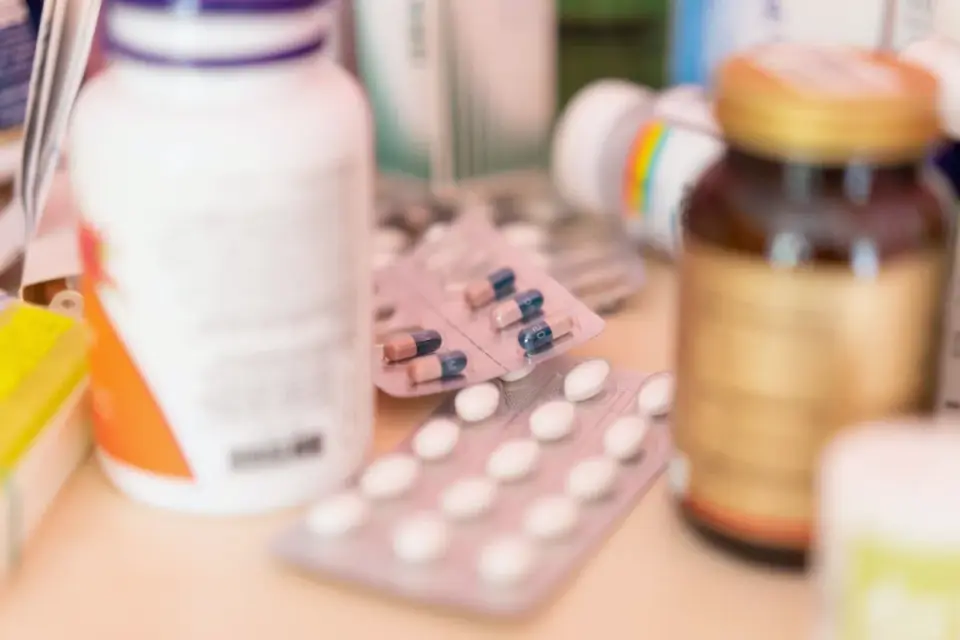
I keep a short mental list for owners who ask me this in an exam room, and I’ll lay it out the same way here:
- Check for fat-soluble vitamins (A, D, E, K) or iron on the label before giving anything from a human bottle — these are the ones that accumulate to dangerous levels.
- Scan the ingredient list for xylitol, especially on gummies and chewables; it’s increasingly common and easy to miss.
- If your dog has joint or mobility concerns specifically, a formulation built and dosed for dogs is doing a different job than a generic multivitamin ever could — mobility supplements target glucosamine, omega-3s, and inflammation pathways at levels a human product isn’t designed to deliver.
- Watch how you’re separating stiffness that comes with age from something that needs a workup; our guide on arthritis versus normal aging stiffness walks through the gait differences worth flagging to your vet.
- If cost is the real driver, ask your vet about lower-cost dog-specific options before reaching for what’s already in the house — the NASC seal is a reasonable shortcut for products that have been through independent quality audits.
- If your dog does get into a bottle of your vitamins, call your vet or ASPCA Poison Control with the label in hand rather than waiting to see what happens.
An owner I worked with, a woman with a 7-year-old Lab mix named Daisy who was just starting to show stiffness getting onto the couch in the evenings, asked me almost the same question Otto’s owner had — could she just split her own glucosamine-and-vitamin-D combo pill instead of buying something dog-specific. I walked her through the vitamin D math on her particular product, and it turned out her pill would have put Daisy well over a safe daily amount even at a quarter dose. We found a joint supplement dosed for Daisy’s 55 pounds instead, and I told her plainly what I tell most owners in that conversation: the supplement’s job is to support her joints alongside the ramp we set up for the couch and the shorter, more frequent walks — not to stand in for either one.
Key takeaways
- Human vitamins are dosed for human body weight and metabolism, not a dog’s, and that gap is where most toxicity happens.
- Vitamin D3, iron, and xylitol account for the majority of dangerous exposures from human vitamin products.
- Dog-specific supplements carrying the NASC seal have been through independent audits for potency, purity, and labeling accuracy that most human products haven’t.
- A supplement supports wellness alongside movement and diet — it doesn’t replace either one.
- If your dog ingests human vitamins, call your vet or poison control with the label rather than waiting.
Frequently asked questions
Can I give my dog a plain vitamin C tablet in an emergency?
Dogs synthesize their own vitamin C and rarely need it, so an occasional small amount typically isn't dangerous, but it also isn't doing much for them — it's not a substitute for a dosed joint or mobility supplement.
What should I do if my dog eats my vitamins?
Call your veterinarian or ASPCA Poison Control with the product label in hand; how urgent it is depends heavily on whether the product contains vitamin D, iron, or xylitol.
Is a NASC seal the same as FDA approval?
No — the FDA doesn't pre-approve supplements for dogs the way it does drugs. The NASC seal means the manufacturer passed an independent third-party audit of manufacturing and labeling practices.
Sources
- Which Supplements and Vitamins Are Dangerous for Pets? — ASPCA
- National Animal Supplement Council — NASC
- Toxicoses in Animals From Human Multivitamins and Supplements — Merck Veterinary Manual