On this page
I don’t think “normal aging stiffness” is a real category of disease, and I’ll defend that. Old age is not a diagnosis. When a ten-year-old Lab takes longer to get up in the morning, something is producing that stiffness — and in the overwhelming majority of cases, that something is osteoarthritis, not the simple passage of years. The American College of Veterinary Surgeons describes osteoarthritis as a common, progressive joint disease that is frequently mistaken for ordinary aging. I want to reason from how the dog actually moves, not from the number on the chart, because gait tells you what’s happening at the joint before an owner can put it into words.
Here’s the biomechanical test I use, and you can use it too: true osteoarthritis stiffness improves with gentle, sustained movement and returns after rest. Muscle fatigue or simple deconditioning tends to do the opposite — it gets worse the longer the dog moves. That single distinction, tracked over a few days, tells you more than almost any other single observation you can make at home.
What “normal aging” actually looks like at the joint level
There is no clean physiological process called “aging stiffness” that is separate from joint disease. What owners describe as their dog “just getting older” is, biomechanically, one or more of a short list of things: mild muscle atrophy from reduced activity, decreased proprioception, reduced cardiovascular tolerance for long walks, and — very commonly — early osteoarthritis that hasn’t been named yet. A dog can be behaviorally slower without joint pain; a dog that’s genuinely deconditioned but pain-free will usually still move symmetrically and won’t guard a limb or shift weight off a leg at a stand. Once you start looking for asymmetry, weight-shifting, or a shortened stride on one side, you’ve moved out of “just aging” territory.
The gait clues that separate the two
I build my assessment outward from load and gait, in this order:
- Warm-up pattern: Arthritic dogs are often stiffest in the first few steps after rest and loosen with movement, then may stiffen again after strenuous exercise. Deconditioning alone doesn’t usually show this rest-then-loosen pattern.
- Symmetry: Watch the dog trot in a straight line. Head-bobbing toward the sound leg, a shortened stride on one side, or a “bunny hop” gait with both hind legs moving together are joint-pain signals, not aging signals.
- Weight-bearing at a stand: A dog that consistently shifts weight off one leg while standing still is protecting a joint, not “just being older.”
- Behavior around specific movements: Reluctance to jump into the car, hesitation before stairs, or a new pause before jumping onto the couch usually reflects a joint that hurts under load, not general slowing.
- Time course: Aging-related slowing tends to be gradual and global. Osteoarthritis often has a more identifiable onset tied to a specific joint, even if the owner didn’t clock it as arthritis at the time.
Owners often ask whether this is worth tracking that closely for what looks like a minor limp. It is. Persistent or worsening stiffness should be assessed by a veterinarian, because osteoarthritis is progressive and early management changes the trajectory.
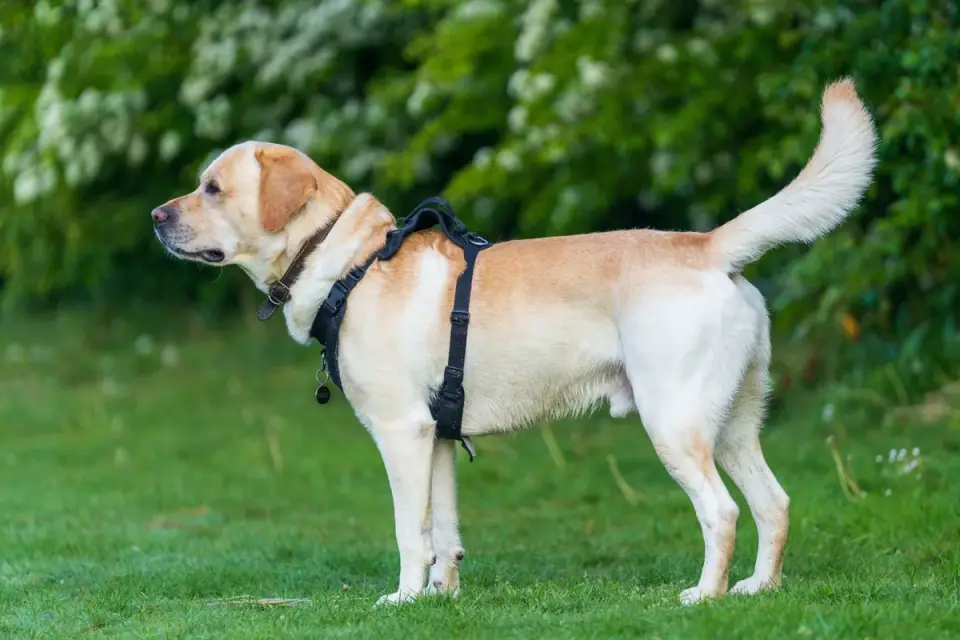
I remember a nine-year-old, 68-pound Golden Retriever named Baxter whose owner brought him in convinced he was “just getting old.” She’d noticed it first in October, on the hardwood floor by his food bowl, when he started taking three or four stiff steps before his hind end would move normally. By December he was skipping his evening game of fetch and needed a running start to get onto the couch. What made it click for me wasn’t any one symptom — it was that his stiffness was worst first thing in the morning, better twenty minutes into a walk, and then noticeably worse again that same evening after a longer hike. That rest-stiff, move-loose, overwork-stiff pattern is a joint signature, not an aging signature. His stride length on the left hind was visibly shorter than the right once we watched him trot on the clinic floor. That’s biomechanics telling you the diagnosis before radiographs confirm it.
Why the distinction matters for what you do next
If it’s simple deconditioning, the fix is mostly building fitness back gradually. If it’s osteoarthritis, the fix is joint-protective: controlled low-impact movement, weight management, home traction, and — where appropriate — supplements that may help support joint comfort alongside those changes, never as a substitute for them. Osteoarthritis is also far more common than most owners assume; a large UK primary-care study found appendicular osteoarthritis in a meaningful share of the general dog population, and joint-specific surveys of older dogs have found Scientific Reports: Prevalence of radiographic appendicular osteoarthritis and associated clinical signs in young dogs is present even before dogs are considered “old,” underscoring that OA is not an old-age-only disease. That’s part of why I push back on the “just aging” framing: it delays owners from starting joint-protective habits years before they otherwise would.
Home management matters as much as anything from the pharmacy. Non-slip runners on hardwood, a ramp or steps to the couch and car, weight checks every few weeks, and short, frequent leash walks over long weekend hikes all reduce the load variability that flares joint pain. If you haven’t audited the house itself, our guide on Signs Your Home Isn’t Safe for an Aging Dog walks through the specific hazards worth fixing first.
Where supplements fit — and where they don’t
Joint supplements are not a diagnostic tool and they’re not a substitute for figuring out which of these two things is happening. I frame them the way I frame every adjunct in a whole-patient plan: they may help support joint comfort and mobility once you already know you’re managing osteoarthritis, layered alongside movement, weight control, and — for many of my patients — acupuncture or chiropractic work. If cost or pill burden is a concern, format matters more than owners expect; our comparison of Freeze-Dried vs Powder Supplements for Dogs covers how absorption and consistency actually differ. None of that replaces a diagnosis.

One thing I’ve learned from years of these appointments: the owners who catch this early are the ones who watched a specific movement, not a vague impression. The owner of a twelve-year-old Beagle told me she almost didn’t mention anything because “he’s just old,” but she’d noticed over about six weeks that he’d stopped following her up the stairs to bed, something he’d done every night for a decade. That single behavioral change, tied to a specific movement and a specific timeline, was worth more diagnostically than a general “he seems slower.” When I hear “he’s just old” paired with a specific, datable change in a specific movement, I don’t accept the “just old” part. I go looking at the joint that change points to.
Your at-home checklist
- Watch the first ten steps after a long rest — stiff then loosening suggests joint pain, not simple aging.
- Watch a straight-line trot for head-bob, shortened stride, or bunny-hopping.
- Note whether the dog shifts weight off one leg while standing still.
- Track specific movements (stairs, car, couch) and the date you first noticed hesitation.
- Bring a dated log to your vet — “gradual slowing” is far less useful than “stiff mornings since October, worse after long walks since December.”
- Don’t wait for limping to be obvious; osteoarthritis is progressive, and earlier management protects function longer.
Frequently asked questions
Can a dog have both normal aging and arthritis at the same time?
Yes. General deconditioning from a less active lifestyle can coexist with osteoarthritis in one or more joints; the gait clues (asymmetry, warm-up pattern, weight-shifting) point specifically to the arthritis component.
Is stiffness that goes away completely after a short walk a good sign?
It suggests the joint still has enough function to loosen with movement, which is common in earlier osteoarthritis, but it doesn't mean there's no joint disease — a veterinary exam is still worth it if the pattern is new or repeating.
How fast does canine osteoarthritis usually progress?
It's variable and depends on the joint, the dog's weight, and activity load, but it's classified as a progressive disease, which is why earlier identification and joint-protective habits matter.
Sources
- Osteoarthritis in Dogs — American College of Veterinary Surgeons
- Prevalence of radiographic appendicular osteoarthritis and associated clinical signs in young dogs — Scientific Reports