On this page
- Start here: the checklist before the breed name matters
- The disputed premise: “they’re basically the same dog”
- Temperament: focus versus proximity
- Exercise and mobility: what the joints are actually doing
- Genetic health checks worth asking about before you commit
- Home setup: what actually changes month to month
- Where the author lands
- Owner checklist: final decision points
Start here: the checklist before the breed name matters
Before we get into coat color or eye shade, run your household against this list. If you can’t check most of these boxes honestly, neither breed is a kind choice.
- You can commit to 60–90 minutes of real physical and mental work daily, not just a yard let-out
- Someone in the house is home for large stretches of the day, or you have a reliable plan for midday enrichment
- You have — or are willing to build — a securely fenced space; both breeds will run through an open gate toward motion
- You’re comfortable with a dog that reads your body language and reacts to it, sometimes before you’ve decided anything
- You can afford CAER eye exams and hip screening as part of routine preventive care, not as an emergency line item
- You’re not adopting to solve boredom in a small apartment with no outdoor access
If that list didn’t scare you off, good — these are two of the most rewarding dogs I work with in practice. Here’s how I actually tell clients to choose between them.
The disputed premise: “they’re basically the same dog”
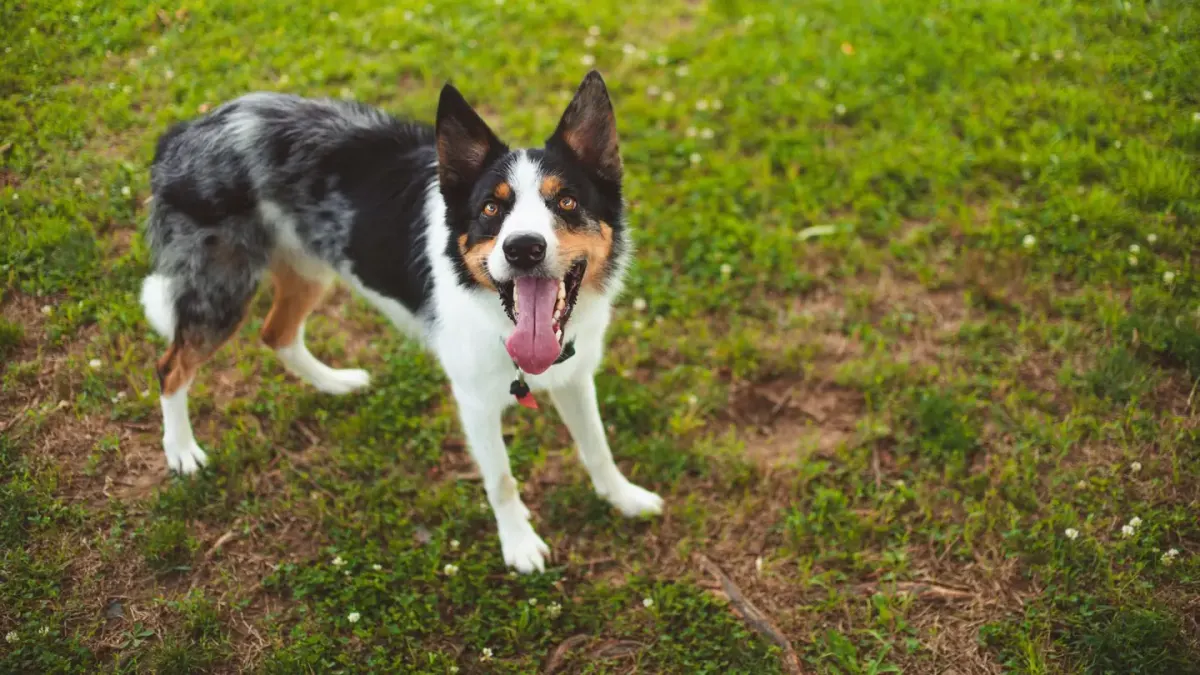
I hear this constantly in exam rooms, and I push back on it every time. Border Collies and Australian Shepherds share a herding job history, a similar size range, and a work ethic that overwhelms an underexercised home. But the way that drive expresses itself is different enough that it should decide which dog goes home with you.
In my practice, I’ve watched this play out with two clients who adopted within the same month, both first-time herding-breed owners, both in suburban homes with modest yards. One brought home a ten-week-old Border Collie pup, sharp-eyed even at that age, who by four months old was crouching and staring at the family’s toddler the way she’d stare at sheep — not aggressive, just locked into a behavior pattern nobody had asked for. The other client’s Australian Shepherd pup, same age bracket, was more interested in staying physically close to whoever was cooking dinner than in controlling anyone’s movement. Both dogs needed the same hour-plus of daily work. But the Border Collie’s owner had to actively manage a herding instinct around kids and bicycles, while the Aussie’s owner was managing a dog that got anxious when left alone in another room. Same energy requirement, genuinely different management problem.
That’s the premise I want you to test against your own life: not “how much exercise” but “what does the intensity look like when it’s not being burned off.”
Temperament: focus versus proximity
Border Collies are typically described as the more singularly focused of the two — bred to work at a distance from the shepherd, reading subtle whistle and hand signals, making independent decisions about how to move stock. That translates at home into a dog that can become intensely fixated on a task, a toy, or a moving object, and that sometimes needs an off-switch taught rather than assumed.
Australian Shepherds were bred to work closer to the handler on ranches, often alongside cattle, and many owners describe a more velcro-like attachment style — a dog that wants to be in the room, not just working in the field. Neither trait is better. It’s a mismatch problem if you don’t know which one you’re getting.
Exercise and mobility: what the joints are actually doing
Both breeds are athletic, mid-sized dogs that cover ground fast and change direction hard — the kind of movement that’s wonderful for cardiovascular fitness and rough on unconditioned joints. A young dog doing repetitive high-impact turns on a hard surface, day after day, is a very different mobility risk than the same dog doing structured, varied movement.
Here’s a short one: build the exercise up, don’t just fill the hour.
That means splitting a 60–90 minute daily requirement across a real walk, a controlled fetch or flirt-pole session, and scent or obedience work that tires the brain without hammering the joints. I ask owners to treat the first year the way you’d treat a young athlete’s training plan — read a related piece on our site, What to Expect in a Labrador Puppy’s First Year, for the growth-plate timeline logic that applies just as much here, even though the breed is different.
Hip health matters in both lines. Registry data compiled by the Orthopedic Foundation for Animals shows hip dysplasia is a documented concern in herding breeds broadly, and both Border Collies and Australian Shepherds appear in breed-specific screening statistics that responsible breeders test against before pairing dogs. If you’re buying a puppy, ask to see the parents’ hip scores — don’t take “healthy line” as an answer on its own.
Genetic health checks worth asking about before you commit
This is where I get specific with clients, because it changes what “healthy puppy” actually means to verify.
MDR1 drug sensitivity. Both breeds carry meaningful rates of the MDR1 gene deletion, which affects how a dog’s body clears certain drugs — including some common parasite preventives and sedatives — across the blood-brain barrier. According to the Collie Health Foundation, dogs homozygous for the mutation are sensitive to ivermectin and several other medications, and the mutation is documented across multiple herding breeds, not just collies by name. A simple cheek-swab test through a veterinary pharmacology lab can tell you a dog’s status before you ever need to prescribe anything higher-risk. I order this test routinely on new herding-breed patients, and I’d ask any breeder whether their breeding stock has been tested.
Collie Eye Anomaly (CEA). This is an inherited eye condition affecting the choroid layer, and it shows up across the collie-type herding breeds, including Border Collies and Australian Shepherds. The OFA: Orthopedic Foundation for Animals recommends CAER eye exams as part of routine screening, since affected dogs can look visually normal in mild cases. A 2022 study on the underlying NHEJ1 gene mutation found that in a sampled Italian Border Collie population, PMC: carrier and affected frequencies were substantial enough to justify genetic testing before breeding, not just eye exams alone — a useful data point if a breeder tells you CEA “isn’t really a concern in this line.”
Neither of these conditions should scare you off the breed. They should change what questions you ask before you bring a puppy home.
Home setup: what actually changes month to month
Both breeds do best with a lifecycle approach to their environment, not a static setup you build once at eight weeks and forget.
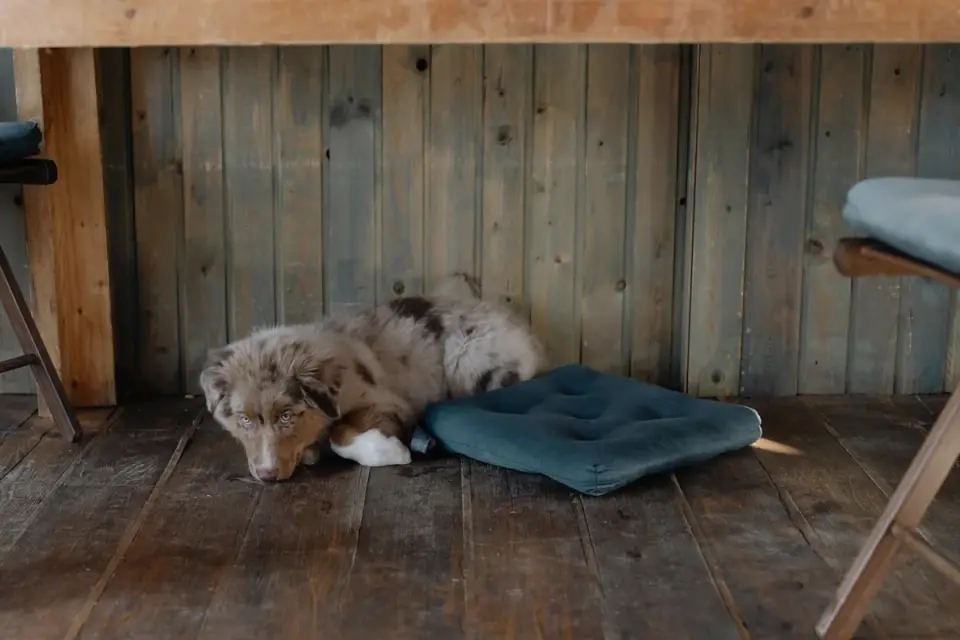
Puppyhood (8–16 weeks): Focus on short, controlled exposure to different surfaces and low-impact play. This is also the window to start crate routines that support calm alone-time skills — our guide on How to Set Up a Crate for a New Puppy’s First Night covers the setup logic, and it applies to both breeds since separation tolerance is something you build early, especially in the Aussie’s more people-oriented temperament.
Adolescence (5–14 months): This is when growth-plate-conscious exercise matters most, and when herding or chasing behaviors toward kids, bikes, or cars tend to emerge in Border Collies especially. Structured recall work and a securely fenced yard aren’t optional here.
Adulthood: Once both breeds are physically mature, daily structured exercise, weight management, and joint-supportive nutrition become the maintenance plan rather than a growth concern. Diet still matters — if you’re building out a home food routine, our piece on Can Dogs Eat Sweet Potato? A Vet’s Guide to Prep, Portions, and Who Should Skip It is a reasonable starting point for a joint-friendly, easily digestible carbohydrate option for active dogs.
Senior years: Watch both breeds for the early signs of slowing — hesitation on stairs, reluctance to jump into the car, a stiffer gait after rest. If you’re already noticing those changes, our article on Common Mistakes When Setting Up a Dog Recovery Space covers the home-setup errors I see most often when owners try to accommodate a stiffening senior without professional guidance.
Where the author lands
I’ll be direct about my own bias, because I think a neutral non-answer isn’t useful to a family trying to decide this month. If a household has young kids, a lot of foot traffic, and moderate but not elite exercise capacity, I lean toward recommending the Australian Shepherd more often — the proximity-seeking temperament tends to tolerate a slightly less perfectly managed environment. If a household has an experienced dog handler, a job or hobby that genuinely uses a dog’s independent problem-solving (agility, real stock work, advanced obedience), I lean Border Collie every time.
The strongest counterargument I hear is that individual variation swamps breed averages — and that’s true. I’ve met velcro Border Collies and independent Aussies. But when a client has no prior herding-breed experience, I’d rather they start with the temperament tendency that’s statistically more forgiving of an imperfect first year, and that’s usually the Aussie.
One family I worked with chose against my lean and got a Border Collie anyway, aware of the tradeoff — they had agility ambitions and the schedule to back it up. Eighteen months later, that dog is doing exactly what it was bred to do, competing at a local level, calm at home because its brain gets used every single day. That’s the outcome you’re buying when you match the dog to the actual life, not the photo.
Owner checklist: final decision points
- If your household has young kids and moderate daily exercise capacity: lean Australian Shepherd
- If you want a dog for a specific working or sport outlet (agility, herding trials, advanced obedience): lean Border Collie
- Either breed: budget for CAER eye exams and hip screening as preventive care, not emergencies
- Either breed: ask about MDR1 testing status in the parents before committing to a puppy
- Either breed: plan exercise as varied and structured, not just “more minutes”
- Either breed: build your senior-year home setup before you need it, not after the first stumble
Whichever way you land, go in with your eyes open about the exercise commitment. Both of these breeds will tell you, loudly and often, when the plan isn’t enough.
Frequently asked questions
Are Border Collies or Australian Shepherds better with kids?
Many Australian Shepherds tend toward a proximity-seeking, people-oriented temperament that can be more forgiving in a busy household with young kids, while Border Collies' intense focus and herding drive often need more active management around running, cycling children. Individual temperament still varies widely, so meet the specific puppy or dog when possible.
Do both breeds need the same amount of exercise?
Both typically need 60–90 minutes of structured daily physical and mental exercise as adults, but the type of activity that satisfies each can differ — Border Collies often need task-focused work, while Australian Shepherds often do well with a mix of physical activity and close handler interaction.
What genetic tests should I ask a breeder about for either breed?
Ask about MDR1 drug sensitivity testing and CAER eye exams for Collie Eye Anomaly, along with OFA hip screening on the parents. These are the most commonly documented heritable concerns across both breeds.
Sources
- MDR1 — Collie Health Foundation
- Collie Eye Anomaly (CEA) — OFA
- Genotypic and allelic frequency of a mutation in the NHEJ1 gene associated with collie eye anomaly in dogs in Italy — PMC