On this page
Every November I hear some version of the same argument: turkey is just meat, dogs eat meat, so what’s the harm in sliding a few slices under the table? I don’t think that premise survives contact with the actual data. Plain turkey muscle meat is genuinely fine for most dogs in modest amounts — but almost nobody serves plain turkey muscle meat. They serve the skin, the pan drippings, the seasoned stuffing that touched it, or a chunk still attached to a bone. That’s the gap between “turkey is safe” and “the turkey on your counter is safe,” and it’s worth being precise about which claim you’re actually making before you feed it.
Quick-scan checklist before you serve any turkey:
- Is it plain — no butter, salt, garlic, onion, or gravy?
- Is the skin removed?
- Is it boneless, with no fragments hiding in the meat?
- Is the portion small relative to your dog’s regular diet (a few bites, not a plate)?
- Does your dog have a history of pancreatitis, GI sensitivity, or a fat-restricted diet?
If you can answer “yes, yes, yes, yes, no” to those five, plain turkey is a reasonable occasional protein. Any “no” in the first four, or a “yes” on the last one, and I’d skip it. Here’s the reasoning behind each line.
What Plain Turkey Actually Offers
Turkey breast is a lean, digestible protein source, which is part of why it shows up in limited-ingredient and novel-protein commercial diets in the first place. For a dog already eating a complete, balanced diet, a few bites of plain cooked turkey is a low-risk treat, not a nutritional gap-filler. It doesn’t need to be dressed up as more than that.
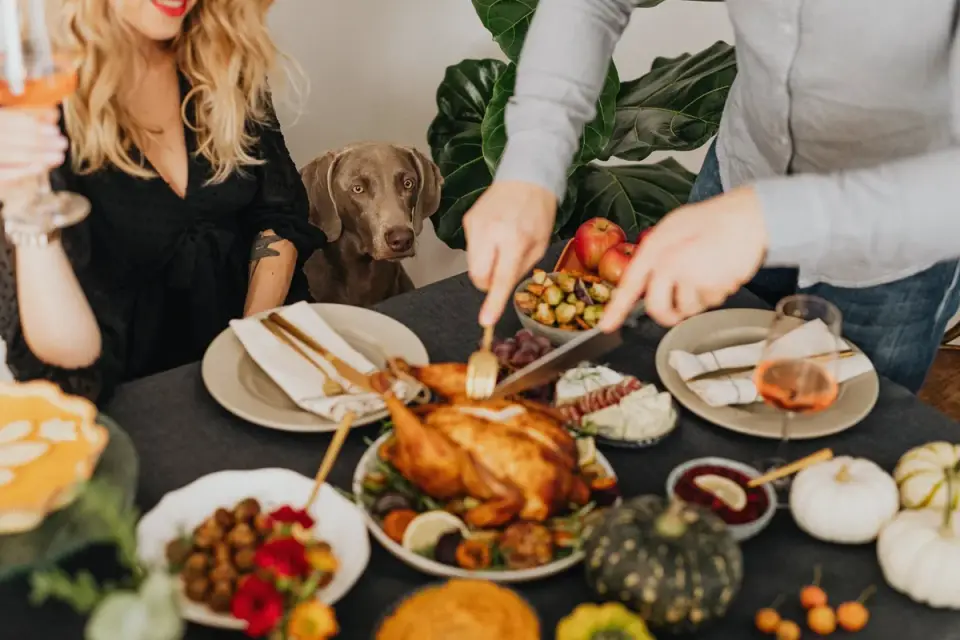
I picture the family standing at the counter on Thanksgiving afternoon, carving knife still in hand, a golden retriever parked directly under the cutting board with her whole body angled toward the smell. The kids want to slip her a piece of skin because that’s the part they’re not eating anyway. The grandmother wants to give her the wing tip, bone and all, because “dogs have always eaten bones.” Both instincts come from affection, and both are exactly backward — the parts humans discard are the parts most likely to end the evening in an emergency vet parking lot instead of on the couch. The plain slice of breast meat sitting untouched in the middle of the cutting board is the safer gift, and it’s also the least exciting one to hand over, which is precisely why it gets skipped.
Where Turkey Goes Wrong: Skin, Fat, and Seasoning
The skin absorbs cooking fat and any seasoning used, and that combination — not the meat underneath — is what most consistently gets linked to pancreatitis and GI upset in dogs, according to the American Kennel Club and PetMD. Garlic and onion, common in stuffing, gravy, and basting, are separately toxic to dogs at even modest doses. None of this requires the meat itself to be dangerous; it requires everything typically served alongside it to be removed.
Pancreatitis itself sits at the more serious end of that spectrum, and when it becomes chronic it can progress toward exocrine pancreatic insufficiency. Veterinary literature on managing that condition describes a combination of low-residue, moderate-fat nutrition alongside enzyme support: “EPI is treated by pancreatic enzyme replacement therapy, nutritional management (low-residue diets with moderate fat content), and supplementation of cobalamin,” per a review in the Journal of the American Veterinary Medical Association. That’s a downstream, worst-case scenario, not what happens after one bite of turkey skin — but it’s the kind of trajectory that makes me conservative about fatty trimmings for any dog with a sensitive pancreas.
Bones Are a Separate Conversation
Don’t lump bones into the same “is turkey okay” question — treat them as their own decision. Cooked turkey bones turn brittle and splinter, and those shards can lodge in the throat, puncture the GI tract, or cause a blockage that needs surgery. Raw bones splinter less but still carry choking risk and can harbor pathogens from an undercooked carcass. My rule with clients has stayed simple for years: no turkey bones, cooked or raw, full stop. The convenience of tossing a carcass in the yard isn’t worth an emergency laparotomy.
When Turkey Becomes a Digestive Problem
Even with plain meat, a rich or unfamiliar protein in a large portion can trigger loose stool or vomiting in a dog whose gut isn’t used to it. If that happens, gut support matters more than another new food. A review of probiotic trials in dogs noted that individual response varies quite a bit — “diversity metrics did not distinguish non-responders from responders,” per Frontiers in Veterinary Science — which is a fair reminder that no single fix works the same way for every dog, and a mild GI upset after table food usually settles faster with bland, familiar meals than with another new ingredient layered on top. If your puppy’s stool doesn’t firm back up within a day or two, our guide on firming up a puppy’s loose stool naturally walks through the next steps.
Working Turkey Into the Bigger Picture
A lean protein like turkey doesn’t do much on its own for a dog’s joints or energy level — it only matters in the context of the whole plan. If you’re managing a senior dog’s weight to take pressure off aging joints, or comparing protein sources the way you might weigh sweet potato as a fiber source, turkey fits as one ingredient among several, not a solution by itself. The same goes for supplement choices: if you’re already checking whether fish oil is safe for your dog long term to support mobility, turkey’s lean protein complements that goal without replacing it. And if your dog seems stiffer once the weather turns — a pattern covered in our piece on whether cold weather makes a senior dog seem more stiff and slow — diet is one lever among several, alongside movement and environment, not the whole answer.
Owner Checklist: Serving Turkey Safely
- Serve plain, boneless, skinless meat only, cut small.
- Skip skin, drippings, gravy, and stuffing entirely.
- Never offer cooked or raw turkey bones.
- Keep the portion small relative to a full meal, especially for dogs prone to pancreatitis.
- Watch for vomiting, straining, or lethargy for 24–48 hours after any new food, and call your vet if anything seems off rather than waiting it out.
Frequently asked questions
Can dogs eat turkey every day?
An occasional plain turkey serving is different from a daily habit. Turkey isn't a complete diet on its own, and a dog eating it daily needs the rest of the bowl balanced by a vet or veterinary nutritionist so protein, fat, and micronutrients still add up correctly.
What part of turkey is worst for dogs?
The skin and any drippings or gravy carry the most risk. They concentrate fat and seasoning, and that combination is the one most consistently linked to digestive upset and pancreatitis in dogs, according to veterinary sources.
My dog ate a turkey bone — what now?
Watch closely for gagging, vomiting, straining, or a reluctant appetite over the next 24–48 hours, and call your vet promptly rather than waiting to see if symptoms resolve on their own, since bone fragments can cause internal injury before obvious signs show up.
Is ground turkey safer than turkey breast for dogs?
Plain ground turkey with no added fat, skin, or seasoning is fine in small amounts, but check the label or ask your butcher, since some ground turkey blends include skin for moisture, which raises the fat content back up.
Sources
- Can Dogs Eat Turkey? Holiday Safety Tips for Pet Owners — American Kennel Club
- Can Dogs Eat Turkey? — PetMD
- Exocrine pancreatic insufficiency in dogs: management review — Journal of the American Veterinary Medical Association
- Probiotic response variability in dogs — Frontiers in Veterinary Science