On this page
Before you scroll further, answer this checklist honestly — it decides more than any temperament chart will:
- Do you have 90+ minutes a day, every day, for structured exercise (not just a walk)?
- Is someone home most of the day, or is this dog facing 8+ hours alone?
- Do you have a fenced yard, or reliable access to a secure off-leash space?
- Is this a first dog, or have you handled a high-drive breed before?
- Are you prioritizing a family companion, or a working partner (sport, protection, service)?
- Can your budget absorb orthopedic screening and, if needed, joint support as the dog ages?
If you hesitated on the first two, I’d steer you toward a German Shepherd from a companion-line breeder before I’d steer you toward a Malinois. Here’s why, and where I’d push back on my own recommendation.
The premise I want to challenge first
Owners come into my exam room with a spreadsheet in their head: Malinois are “more intense,” Shepherds are “the family version.” That’s roughly true, but it undersells how much variation exists within each breed, and it skips the question that actually predicts whether the placement works — not breed, but job.
I had a family bring in a 14-month-old Belgian Malinois named Kessel, 55 pounds, adopted from a police-line breeder because “he was the last pick of the litter and so cute.” Within three months he’d chewed through two crate doors and was pacing the length of their kitchen at 5 a.m. He wasn’t a bad dog. He was a working dog with no work. Compare that to a German Shepherd I see for routine visits, a nine-year-old female named Ruger, still doing 45-minute structured walks and light tracking games in the yard, whose owners built her exercise into their own daily schedule from week one. Same drive category, entirely different outcome, because the humans matched the routine to the dog rather than the dog to the fantasy.
Where the two breeds actually diverge
The German Shepherd Dog breed page describes the ideal as a large, agile, muscular worker of “noble character,” bred as an all-purpose herder and later adapted into military, police, and service roles. Most adult Shepherds need roughly 60–120 minutes of real exercise a day, and physical activity alone rarely satisfies them — they also need a job for their brain, whether that’s obedience work, nose games, or structured training.
The Belgian Malinois runs hotter. Per the Is the Belgian Malinois the Right Dog Breed for You?: AKC’s guide on whether a Belgian Malinois is right for you, the breed is intelligent, people-oriented, and highly work-driven, with working lines carrying particularly high drive — it’s the most common breed in police and military K9 roles worldwide for a reason. A bored Malinois doesn’t sulk quietly; it finds its own job, and you usually won’t like the job it picks.
Practically, that means:
- Exercise ceiling: Shepherds max out satisfied around 90–120 focused minutes daily; many Malinois owners report the dog is still keyed up after that.
- Novice tolerance: Shepherds are more forgiving of an inconsistent routine; Malinois are less so.
- Household tempo: Shepherds generally settle indoors once worked; Malinois often need an actual off switch trained deliberately.
The joint-health side nobody puts on the comparison chart
Here’s where I’d push back on the “Malinois is just a harder Shepherd” framing. Orthopedic risk is not the same, and it changes how I counsel each family about long-term mobility planning.
According to a review from the UFAW Science for Animal Welfare database on German Shepherd hip dysplasia, roughly 20% of Shepherds screened in the U.S. OFA database between 1974 and 2015 showed hip dysplasia, with dogs born 2011–2015 still around 18%. Malinois, by contrast, screen at a markedly lower rate — closer to 5% incidence in more recent breed rankings, reflecting a comparatively low risk of hip and elbow dysplasia for the breed as a whole.
That single fact changes my counseling. With a Shepherd puppy, I start hip and joint conversations early: controlled growth-phase exercise, lean body condition, and — once the dog is done growing — a plan for joint support that fits an at-risk large breed. With a Malinois puppy, joint risk still exists and screening still matters, but the more urgent conversation is usually behavioral: channeling drive before it becomes a coping problem.
What I actually tell families in the room
I had a couple last spring debating between a Shepherd and a Malinois for what they called “an active but normal life” — two working professionals, a fenced quarter-acre yard, weekend hikers, no dog sport ambitions. I told them plainly: get the Shepherd. Not because the Malinois is a worse dog, but because their available hours didn’t match what a Malinois needs to stay sane. A year later they have a two-year-old Shepherd who hikes with them Saturdays and naps hard the rest of the week. That’s the outcome I want families walking toward — a dog whose needs match the life actually being offered, not the life being aspired to.
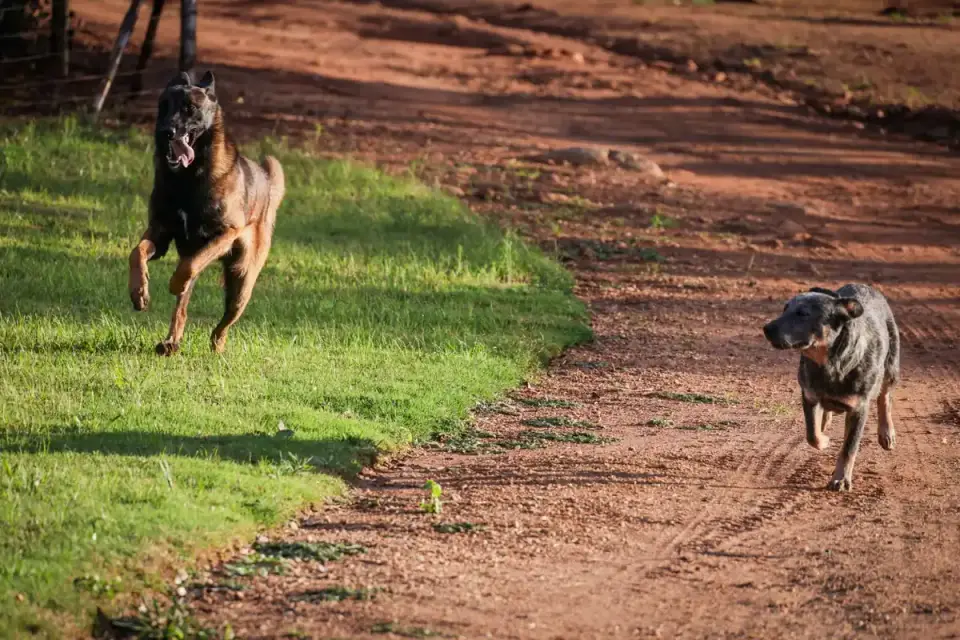
If a family tells me they want a dog for a sport like French ring, IPO, or serious protection work, I’ll recommend the Malinois without hesitation — that’s the breed built for it, and an underworked Shepherd in that role is often the frustrated one instead. The counterargument to my Shepherd-first lean is real: plenty of Malinois thrive as family dogs when owners commit to daily structured work from day one. I still land on Shepherd-first for most first-time or moderately active households, because the margin for error is wider and the fallout from an under-exercised Shepherd is milder than the fallout from an under-exercised Malinois.
Building the routine either breed actually needs
Whichever breed you choose, the mobility and joint-care basics look similar, just dialed to different intensities:
- Keep puppies lean through the growth phase — extra weight on an immature hip is the single most controllable dysplasia risk factor, regardless of breed.
- Split daily exercise into two sessions rather than one long one; both breeds handle a morning and evening block better than a single marathon walk.
- Add mental work — tracking, puzzle feeding, structured obedience — on top of physical exercise, especially for the Malinois.
- Set up a home recovery space now, before you ever need one, so growth-plate injuries or post-exercise soreness have somewhere calm to land; see our guide on avoiding common mistakes when setting up a dog recovery space.
- If you’re building a puppy’s routine from scratch, our month-by-month framework in what to expect in a Labrador puppy’s first year covers growth-plate pacing that applies across large breeds, not just Labs.
- For an aging Shepherd losing stair confidence, a ramp is often the first low-cost fix — our DIY dog ramp build guide walks through it step by step.
The checklist, one more time, now with reasons attached
- 90+ minutes daily, non-negotiable? Malinois lean; Shepherd if you’re not fully sure.
- Someone home most of the day? Both breeds struggle alone; Malinois struggles harder and faster.
- Secure yard or off-leash access? Non-negotiable for either breed, more urgent for Malinois.
- First high-drive breed? Start with the Shepherd.
- Sport or working goals? Malinois, without much debate.
- Budget for orthopedic screening and joint support as the dog ages? Plan for it either way — heavier for the Shepherd, but never skip it for the Malinois.
I don’t think there’s a wrong breed here, only a wrong match. Pick the one whose actual daily demands you can meet on your worst week, not your best one — and re-run this checklist again once the dog is two years old, because the honest answer sometimes changes once the puppy energy burns off and the adult dog’s real personality settles in.
Frequently asked questions
Are Belgian Malinois more aggressive than German Shepherds?
Not inherently — both breeds can be confident and protective, but a Malinois's high working drive is often mistaken for aggression when the dog simply isn't getting enough structured outlet for its energy.
Which breed is easier for a first-time dog owner?
Most families do better starting with a German Shepherd from companion lines; the breed is generally more forgiving of a less rigorous daily routine than a working-line Malinois.
Sources
- German Shepherd Dog — American Kennel Club
- Is the Belgian Malinois the Right Dog Breed for You? — American Kennel Club
- German Shepherd Hip Dysplasia — UFAW Science for Animal Welfare