
On this page
I don’t think l-carnitine and creatine are interchangeable, and I want to say that before we go any further, because I hear owners use the two names like synonyms in my exam room. They’re not. One shuttles fat into the mitochondria to be burned as fuel. The other regenerates the phosphate bond that gives a muscle fiber its next instant of contraction. Different jobs, different tissue effects, and — this is the part that actually matters for your dog — different levels of canine-specific evidence behind them.
A twelve-year-old Labrador named Otis is the dog who made me sort this out properly. His owner brought him in because he was struggling to get up off the kitchen floor by 6 p.m. every evening, though he was fine in the morning. Otis weighed 71 pounds, had mild hip dysplasia on imaging, and had lost visible topline muscle over about four months — you could see the dip along his lumbar spine that hadn’t been there the year before. The owner had already tried a joint chew with glucosamine and wanted to know whether to add “the muscle stuff” next, and whether it should be carnitine or creatine. That question is really a question about what’s failing: fuel delivery to the muscle, or the muscle’s ability to fire quickly once it’s asked to move. With Otis, the exam pointed at disuse atrophy from an aging, arthritic hip — not an energy-metabolism problem — which changed what I recommended.
What l-carnitine is actually doing inside the muscle cell
Carnitine’s job is transport. It ferries long-chain fatty acids across the mitochondrial membrane so they can be oxidized for energy, and dogs with low body carnitine — some breeds prone to dilated cardiomyopathy, or dogs on certain restrictive diets — can end up with heart and skeletal muscle that isn’t fueling itself efficiently. The most direct canine data I’ve found on skeletal muscle specifically comes from a study of Labrador Retrievers published in PLOS ONE, where dogs supplemented with 250 mg/day of l-carnitine gained lean mass while unsupplemented dogs lost it over the study period, and showed lower post-exercise creatine phosphokinase and myoglobin — both markers of muscle-fiber damage — after intensive running. That’s a meaningful signal for exercise recovery and for maintaining lean tissue, and it lines up with what carnitine is built to do metabolically.
What it isn’t is a strength or power intervention. Carnitine doesn’t touch the immediate energy system a muscle uses for a single hard contraction — the sprint off the couch, the lunge up three stairs. It works on the sustained, aerobic side of muscle function: recovery, fat utilization, and resisting the kind of fiber breakdown you see in a dog that’s out of conditioning and suddenly asked to do more.
What creatine does — and why the canine research looks different from the human aisle
Creatine’s role is more mechanical. Muscle stores it as phosphocreatine, which regenerates ATP almost instantly during short, explosive effort — the first few seconds of a sprint, a jump, a stair climb. In humans this is extremely well studied. In dogs it’s thinner, and the studies that do exist are worth knowing precisely because they don’t all point the same direction. Research on diet-derived creatine and creatinine, published in the Journal of Animal Physiology and Animal Nutrition, found that the amount and source of creatine in a dog’s regular diet already varies quite a bit depending on the meat content and processing of the food — which matters, because it means “baseline” creatine status isn’t the same across all dogs before you even add a supplement.
A separate look at supplemental dietary creatine and its effect on plasma and muscle creatine concentration, published in The Journal of Nutrition, found that muscle creatine rose meaningfully in dogs that started with low initial creatine levels, but the effect was negligible in dogs whose muscle creatine was already adequate. That’s an important nuance: creatine supplementation in dogs looks like it corrects a deficit rather than boosting an already-sufficient system, which is a different claim than the one made in most human sports-nutrition marketing.
For the aging or post-surgical dog losing muscle
This is where I land on l-carnitine more often than creatine. An older dog like Otis, or a dog several weeks out from cruciate surgery, is usually dealing with disuse atrophy and reduced fat-burning efficiency at rest, not a shortage of instant power. Structure and function language matters here: carnitine may help support normal fat metabolism and muscle recovery, alongside a rehab or conditioning plan — it isn’t a stand-alone fix, and I never present it as one.
For the working, sporting, or agility dog
Creatine’s mechanical story fits better for a dog whose job is repeated short bursts — agility runs, flyball, field trials. The caveat from the research above still applies: if that dog’s diet and muscle creatine are already adequate, additional supplementation may add little. I’d rather see a body-condition and gait assessment first than default to a creatine product because it worked for a human athlete.
Testing the premise against the whole dog, not just the muscle
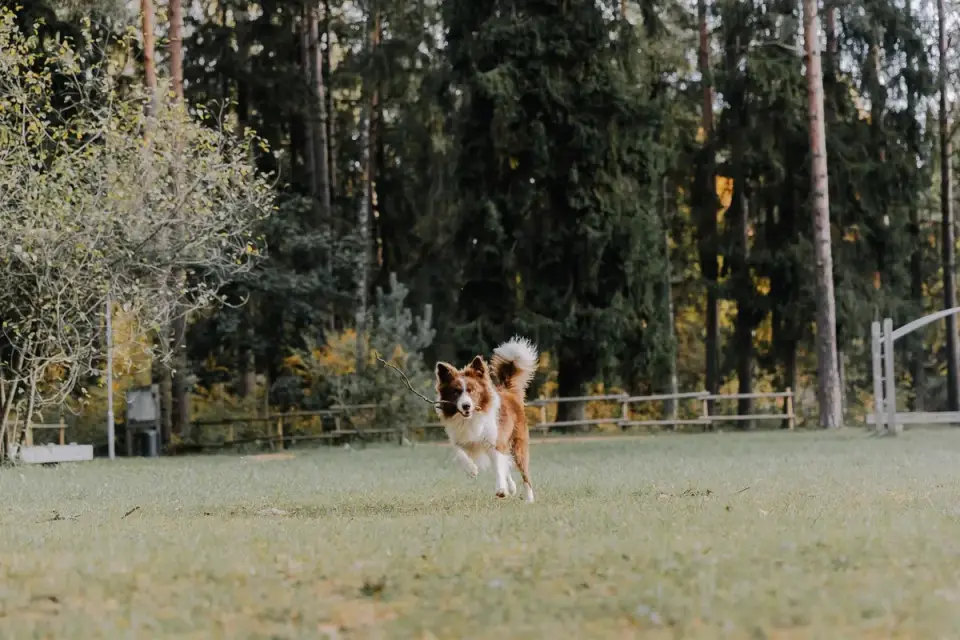
I keep coming back to a border collie named Piper I worked with a few springs ago — six years old, 38 pounds, competing in agility most weekends. Her handler noticed Piper was slower out of the start line and seemed to hesitate before weave poles, something that hadn’t happened the season before. On exam, Piper’s muscle mass was fine and her gait was symmetrical; nothing about her build suggested atrophy. What had changed was her training volume — she’d gone from two practice sessions a week to four, with almost no rest days between. We didn’t reach for a supplement first. We built in recovery days, checked her weight against her competition photos from the prior year, and only after that did we discuss whether a creatine-containing product made sense for her training block. Muscle support supplements work on the margins. They don’t replace load management, and they can’t fix a schedule that’s outpacing recovery, no matter which one you pick.
That’s the pattern I’d ask every owner to check before shopping: is the muscle loss or slowdown coming from insufficient recovery, an underlying joint problem limiting movement, simple deconditioning, or a genuine metabolic gap? Those look similar from the couch but call for different responses.
Where supplements fit in a whole-dog mobility plan
Neither carnitine nor creatine does anything for the joint itself, and neither replaces a structured return-to-movement plan. If your dog’s real issue is stiffness or reduced range of motion rather than muscle wasting, it’s worth sorting out whether you’re looking at arthritis or ordinary age-related stiffness first — the article on arthritis vs. normal aging stiffness in dogs walks through the gait clues that separate the two, and that distinction changes whether a muscle-support supplement is even the right next step.
If you do move forward with either ingredient, format matters almost as much as the ingredient choice. A dog with a sensitive stomach or reduced appetite from age may do better with a chew than a powder mixed into food that gets left in the bowl; our comparison of chew vs. powder vs. liquid supplements for dogs covers absorption and compliance trade-offs across the common delivery formats. And if shelf stability or dosing precision is the sticking point, the breakdown of freeze-dried vs. powder supplements for dogs is worth reading before you commit to a product.
However you source either ingredient, look for the National Animal Supplement Council Quality Seal on the label. It doesn’t guarantee a specific outcome for your dog, but it does mean the manufacturer has passed an independent audit covering quality control, adverse-event reporting, and label accuracy — a baseline I’d want under any supplement claiming to affect muscle tissue.
Your checklist before you add either one
- Confirm what’s actually changing: muscle loss, slower recovery, or joint-driven reluctance to move. They call for different responses.
- Ask what your dog’s job is day to day — steady walks and stairs point toward carnitine’s recovery and fat-metabolism role; short explosive sport work points toward creatine’s mechanical role.
- Check whether your dog’s diet already delivers adequate creatine before assuming a deficit exists; the canine research suggests supplementation helps most when a real shortfall is present.
- Treat either ingredient as one part of a plan that includes movement, weight management, and — where indicated — a vet-guided rehab program, never as a stand-alone fix.
- Look for the NASC Quality Seal and a transparent label before buying either ingredient from any brand.
Otis, for what it’s worth, went on a short-course carnitine-containing supplement alongside a twice-daily ramp-assisted walk routine and a slower-feeder bowl to manage his weight. His owner reported easier evening stands within a few weeks — one dog, one case, not a study result, but it’s the kind of change that tells me we matched the tool to the actual problem instead of the label on the tub. That’s the habit I’d want every owner to build: name what’s failing in the body before you name the supplement.
Frequently asked questions
Can I give my dog both l-carnitine and creatine at the same time?
There's no established canine research on combining them for muscle support, so I'd rather see one ingredient introduced at a time and matched to what your dog's exam actually points toward — talk to your vet before stacking supplements.
Is creatine safe for dogs the way it's used in human sports nutrition?
Canine-specific dosing and long-term safety research is much thinner than the human literature, which is part of why I treat creatine as situational — appropriate to discuss for a working or sporting dog, not a default add for every dog.
Will l-carnitine help a dog that's just naturally leaner with age?
Some age-related muscle loss is simply reduced activity and normal aging, not a metabolic deficit — that's a conversation for your vet, and carnitine may help support recovery and fat metabolism, but it won't reverse disuse atrophy on its own.
Sources
- Utilisation of supplemented l-carnitine for fuel efficiency, as an antioxidant, and for muscle recovery in Labrador retrievers — PLOS ONE
- Creatine and creatinine contents in different diet types for dogs – effects of source and processing — Journal of Animal Physiology and Animal Nutrition
- Changes in Plasma and Muscle Creatine Concentration after Increases in Supplementary Dietary Creatine in Dogs — The Journal of Nutrition
- National Animal Supplement Council — NASC