On this page
Is skipping the trigger a failure, or is it the plan? I get asked some version of that question almost every week, usually from an owner who feels guilty for crossing the street instead of “working through it.”
A client brought in a two-year-old Cattle Dog mix named Scout last spring — 42 pounds, reactive to skateboards, and the owner had been forcing three-times-a-week exposure walks past the skate park because a trainer online said avoidance was “reinforcing the fear.” Scout was worse by week four: more barking, faster escalation, a longer recovery time after each pass. When we mapped out what was actually happening, the walks were flooding him, not desensitizing him. We swapped the skate-park route for a quiet greenway for six weeks — pure management, no exposure at all — and only then layered in a slow counterconditioning plan starting at a distance where Scout could still eat a treat. By week ten he could watch a skateboarder from thirty feet without shutting down. The lesson I keep relearning with dogs like Scout: management isn’t the opposite of training, it’s the floor training stands on.
What management actually changes vs what training changes
Management changes the environment so the unwanted behavior can’t happen, or happens far less. Training changes the dog’s underlying response to the trigger itself. If you put up a baby gate so your dog can’t get to the front door when the mail carrier arrives, that’s management — you’ve removed the opportunity, not the reaction. If you spend six weeks pairing the mail truck’s sound with chicken at a distance the dog can handle, that’s training — you’re rewiring what the sound predicts.
Neither one is the “real” solution and the other the shortcut. They solve different problems. Management buys you a lower-stress household today. Training changes tomorrow’s baseline. Most dogs I see benefit from both running at the same time, with management doing the heavy lifting early while training compounds slowly in the background.
When avoidance is the correct call, not a cop-out
I tell owners this a lot: if a trigger is rare, high-intensity, and not central to the dog’s daily life, permanent avoidance can be the entire plan. A dog who panics at fireworks doesn’t need a desensitization protocol built around New Year’s Eve — he needs a safe room, white noise, and a night indoors. Trying to “train through” a trigger that shows up twice a year isn’t efficient use of anyone’s time, and repeated poorly-managed exposure can make the fear worse, not better.
Avoidance stops being the right call when the trigger is unavoidable in normal life — other dogs on walks, houseguests, car rides, veterinary visits. For those, management alone leaves the dog managing a shrinking world. That’s where training earns its keep.
Reading the trigger before you decide
Before I recommend either path, I want three things mapped out: how often the dog actually encounters the trigger, how severe the reaction is when it happens, and how much control the owner realistically has over the environment. A dog who lunges at the doorbell needs a different plan than a dog who freezes at the vet clinic, because the doorbell is controllable — you can turn off notifications, use a physical barrier, teach a “go to mat” behavior — and the vet visit is not something most families can simply avoid forever.
One short truth I give every owner in this conversation: you cannot train a dog who is over threshold.
If the dog is barking, panting hard, or unable to take treats, no learning is happening in that moment — only rehearsal of the panic response. That’s exactly why management (distance, a barrier, a different route) has to come first in almost every reactive-dog case I work. It lowers the intensity enough that training can actually start.
Where calming support fits, and where it doesn’t
Supplements are not a substitute for either management or training — I’ve had owners hope a chew would replace the work, and it never does. What calming ingredients can do is take the edge off a dog’s baseline arousal so training sessions go better and management routines are easier to hold to. Chamomile and valerian root have a long history in traditional herbal care for supporting relaxation, and according to a review in Biomedicines, for many species the evidence behind chamomile’s calming effects still comes mainly from preclinical studies or traditional use rather than large controlled trials in dogs — worth knowing before you expect a dramatic shift.
Ashwagandha has more human data behind it. A systematic review published in Cureus looked across multiple randomized controlled trials and found a moderate positive impact on stress reduction and cognitive performance, though again, that evidence base is largely human. L-theanine, the calming amino acid found in tea, has similar mixed footing — a review in Molecular Psychiatry found benefit across most anxiety studies except one trial in psychotic anxiety, using doses around 400 mg/day for eight weeks in human subjects. None of this tells us a chew will fix reactivity. It tells us these are reasonable, low-risk additions to a plan that’s already doing the real work of management and training.
Building the routine that actually holds up
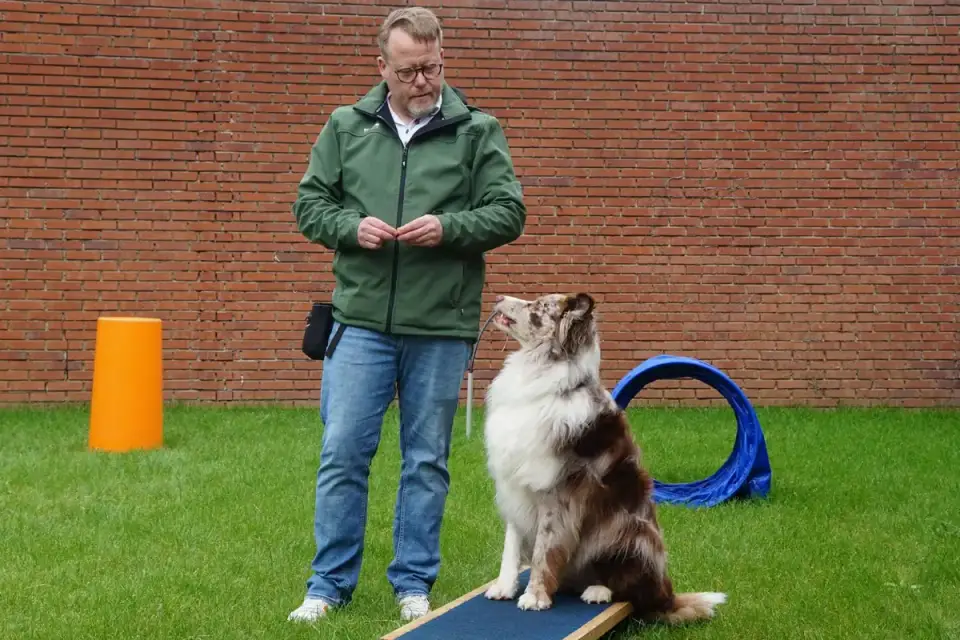
A workable plan almost always has three layers stacked on top of each other. First, management: remove or reduce access to the trigger so the dog isn’t rehearsing the reaction daily. Second, a graded training plan that starts well below threshold and moves at the dog’s pace, not a calendar. Third, the supporting cast — sleep, exercise, and where appropriate, calming supplementation — that makes the first two layers easier to sustain. Skip the first layer and training stalls because the dog is flooded constantly. Skip the second and you’ve built a life that shrinks around the trigger forever.
I worked with a Golden Retriever named Piper, nine years old, whose owner was managing severe noise sensitivity by keeping her in a basement crate during every thunderstorm — which kept Piper physically safe but did nothing for the underlying fear, and by the third summer she’d started panting and pacing at the first hint of cloud cover, hours before any thunder. We kept the safe space (good management) but added a slow, structured desensitization protocol using recorded storm sounds at a volume Piper could ignore, building up over eight weeks. Her owner also asked about supplements, and we discussed L-theanine as a reasonable low-risk option to try alongside the plan, not instead of it. By the following storm season Piper still went to her safe spot, but she got there calmer and recovered faster afterward. That’s realistic progress — not a cure, a shift in baseline.
If you’re trying to sort out whether your own dog’s behavior is more about boredom or something more anxiety-driven, it’s worth reading through Boredom vs Separation Anxiety: How to Tell the Difference before you build a plan, since the two call for different management strategies. And if temperament differences between individual dogs are part of what’s shaping your read on the situation, Male vs Female Dogs: Do Temperament Differences Matter is a useful companion piece.
Your checklist going into this
- Map the trigger: frequency, severity, and how controllable the environment actually is.
- If the trigger is rare and not central to daily life, permanent avoidance is a legitimate, complete plan.
- If the trigger is unavoidable in normal life, pair management now with a graded training plan that starts below threshold.
- Never expect training progress while the dog is visibly over threshold — lower intensity first.
- Treat calming supplements as support for the plan, not a replacement for either management or training.
- Reassess every few weeks; a good plan shifts as the dog’s baseline improves.
Where this goes next depends on the dog in front of you, not a fixed timeline — some dogs need weeks of pure management before training even starts, others are ready sooner. Either way, the plan should keep loosening its grip on the trigger over time, not stay frozen at week one forever.
Frequently asked questions
Is management just giving up on training a dog's reactivity?
No. Management removes or reduces the dog's exposure to a trigger so the behavior doesn't get rehearsed, while training changes the dog's underlying response over time. Most reactive-dog plans need both, often with management doing the early lifting while training builds slowly.
How do I know if I should just avoid a trigger instead of training around it?
If the trigger is rare, high-intensity, and not something the dog encounters in normal daily life — fireworks, a specific loud event — permanent avoidance can be the whole plan. If the trigger is unavoidable, like other dogs on walks or vet visits, management alone isn't enough long-term.
Can calming supplements replace management or training?
No. Ingredients like chamomile, ashwagandha, and L-theanine may help lower a dog's baseline arousal, which can make management and training easier to carry out, but the evidence behind them doesn't support using them as a standalone fix.
Sources
- Chamomile and related botanicals in anxiety and stress: a review — Biomedicines
- Ashwagandha and stress reduction: a systematic review — Cureus
- L-theanine and anxiety outcomes: a review — Molecular Psychiatry