
On this page
The Premise I Want to Push Back On
Owners bring me a version of this question constantly: if my dog gets to run flat-out at the dog park twice a week, do I still need to bother with boring, structured leash walks? The premise underneath that question is that “exercise” is fungible — that enough off-leash time can substitute for the plodding, on-leash mile. I don’t think that premise survives contact with how a dog’s joints and cardiovascular system actually adapt to load. Off-leash play and leash walking are not interchangeable units of exercise; they train different tissues, at different intensities, with different injury profiles. Treating them as swappable is where a lot of owners quietly shortchange the dog’s joints while thinking they’re doing plenty.
What Off-Leash Movement Actually Does to a Dog’s Body
Off-leash time is where a dog gets to move like a dog: sprinting, cutting, pivoting, and jumping in ways a leash physically prevents. That variability is genuinely valuable — it recruits stabilizer muscles, tests proprioception, and gives a dog the kind of cardiovascular spike that a plodding walk never will. The tradeoff is that unstructured, self-paced sprinting and cutting also load joints unevenly and unpredictably, which is exactly the mechanism behind a lot of the soft-tissue injuries I see in sporting and working dogs. A Journal of the American Veterinary Medical Association analysis of dog-walking injuries underscores a related point that owners underweight: leash-adjacent incidents are common enough to study seriously, and off-leash environments carry their own, separately documented set of dog-to-dog and terrain-related injury risks. Off-leash play isn’t dangerous by default. It’s just higher-variance, and variance is exactly what an arthritic or recovering joint tolerates worst.
What the Leash Mile Does That Off-Leash Play Can’t
A controlled leash walk is comparatively unglamorous, and that’s the point. Walking at a steady pace on a reasonably soft surface loads every limb in a predictable, repeated pattern — the same stride, the same joint angles, over and over, at an intensity the dog isn’t choosing to escalate mid-stride. That repeatability is what actually conditions muscle around a joint and reinforces a normal gait pattern, according to guidance from VCA Animal Hospitals on exercising dogs with osteoarthritis, which treats regular, controlled activity as one of the core pillars of managing joint disease alongside weight control and pain management. A leash walk is also the only version of “exercise” you can dose precisely — you decide the distance, the pace, and when to stop, which matters enormously for a dog recovering from surgery, carrying extra weight, or simply getting older.
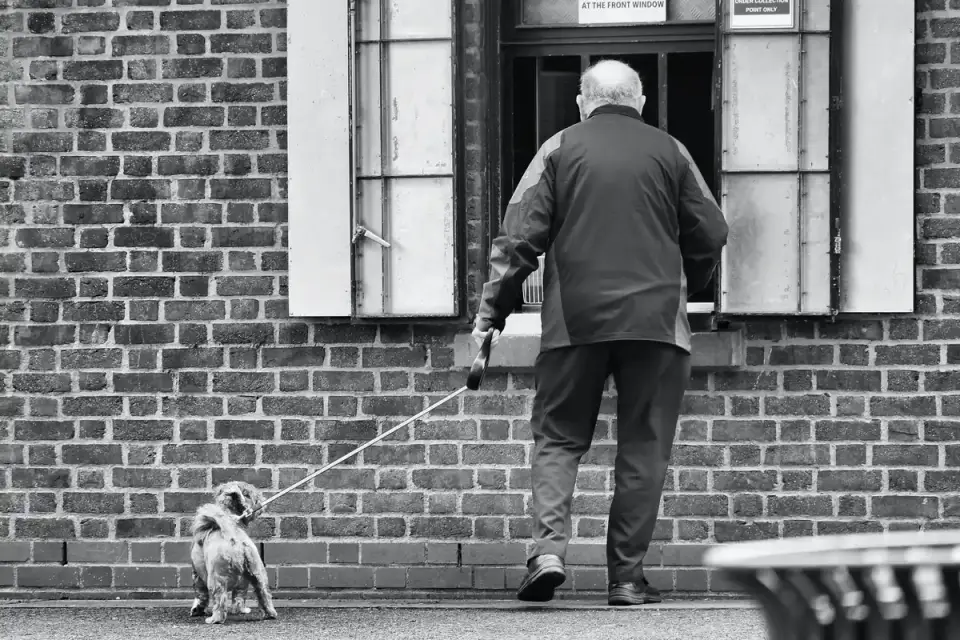
I had a client, a nine-year-old mixed-breed named Daisy who weighed close to 70 pounds, whose owner described her as “still a puppy at the dog park” — she’d sprint after other dogs for twenty minutes straight, then spend the next two days stiff getting up from the kitchen floor. What the owner hadn’t connected was that Daisy’s only other activity was a five-minute bathroom-break leash walk twice a day. She had almost no conditioning between those off-leash bursts, so every park visit was effectively her only real workout, taken at maximum intensity on a joint with early arthritic changes. We didn’t take the park away. We added two two 15-minute controlled leash walks on grass most days of the week, and within about six weeks the owner reported Daisy was climbing onto the couch again without the running start she’d started using.
Where Joint Support Fits in This Picture
However a dog splits its week between off-leash bursts and leash mileage, the joints doing that work are made of cartilage, synovial fluid, and connective tissue that benefit from targeted nutritional support — this is where I try to ground the supplement conversation in the actual evidence rather than marketing language. Chondroitin has research behind it for supporting healthy synovial fluid homeostasis, per a study published in Frontiers in Veterinary Science, and glucosamine and chondroitin remain among the most studied joint-support ingredients used in dogs. Glucosamine HCl specifically has been shown in laboratory research to help prevent experimentally induced cartilage degradation in vitro, according to a review in the Journal of Veterinary Medical Science — evidence that’s mechanistic rather than a guarantee of clinical outcome, which is an important distinction to hold onto. Green-lipped mussel powder has a different but complementary evidence base: research in Nutrients found that mussel-derived compounds alleviated paw swelling and reduced markers of inflammation, including rheumatoid factor and pro-inflammatory cytokines, in animal models. None of that is a substitute for the exercise plan itself. It’s a supporting layer for joints that are already being asked to do the right kind of work — and I’d rather a client spend their money on both a sound routine and a well-formulated joint supplement than lean on either one alone.
Building a Week That Actually Uses Both
Structure the week instead of picking a side.
- Anchor 4–5 days with a controlled leash walk of 15–25 minutes on a forgiving surface — grass, dirt, or packed trail beats concrete for a dog with any joint sensitivity.
- Reserve off-leash sessions, 2–3 times a week, for a securely fenced area or a well-trained recall situation, and cap the highest-intensity sprinting to 10–15 minutes so it stays a stimulus, not the dog’s entire cardio budget.
- Warm up before off-leash play with five minutes of leash walking; a cold sprint into hard cutting is where a lot of soft-tissue strains start.
- Watch recovery, not just the session. A dog who’s markedly stiffer the next morning after a park visit needs more conditioning walks, not fewer park trips.
- If your dog’s exercise options are constrained by housing — this comes up constantly with owners we work with on Best Dog Breeds for Apartment Living, where daily leash mileage often has to substitute for a big fenced yard — lean harder into consistent leash walks and treat off-leash time as a scheduled outing rather than a daily default.

A Second Case That Stuck With Me
A client’s seven-year-old Border Collie, Scout, was a different problem entirely — high-drive, herding-line dog whose owner worried that daily on-leash walks alone were leaving her understimulated and, frankly, a little destructive indoors. Scout was structurally sound; the issue wasn’t her joints, it was that leash walking alone couldn’t meet a working-line dog’s need for varied, self-directed movement. We kept the daily 20-minute structured walk for conditioning, but added two off-leash flirt-pole and fetch sessions a week in a fenced yard, each capped around 12 minutes to avoid the compounding fatigue that shows up as sloppier landings later in a session. The owner noticed Scout settled faster in the evenings within about three weeks, and — just as importantly — never developed the intermittent hind-limb hitch her littermate had after a summer of unrestricted, daily off-leash running. Two dogs, two very different reasons to keep both kinds of exercise in the rotation. Breed and drive shape how you weight the split, and this is also where I’d point owners researching coat- or skin-driven breed questions, like those covered in Best Hypoallergenic Dog Breeds for Allergy Sufferers, toward the reminder that exercise tolerance and joint risk vary by breed structure just as much as coat type does.
The Owner’s Checklist
Before you settle on a weekly split, run through this:
- Does your dog have any diagnosed joint issue, recent surgery, or excess weight? If so, leash-controlled mileage should be the default, with off-leash time added cautiously.
- Is your dog’s recall reliable enough that off-leash time doesn’t turn into an uncontrolled sprint on pavement or around other dogs?
- Are you warming up before high-intensity off-leash play, even briefly?
- Are you tracking next-day stiffness, not just how tired the dog seems that evening?
- Is a joint-support supplement part of the plan for an aging or already-arthritic dog, layered onto the exercise routine rather than replacing it?
Neither format wins outright. Leash walks give you the dosable, repeatable mileage that actually conditions a joint over time; off-leash play gives a dog the variability and drive-satisfaction a leash can’t. Build a week around both, weighted by your dog’s age, structure, and history, and support the joints doing the work with ingredients that have real evidence behind them.
For related context, read Can Dogs Eat Grapes? No — Here’s Why Even a Few Are Dangerous.
For related context, read Are Mushrooms Safe for Dogs? What the Cap on Your Cutting Board and the One in Your Yard Don’t Share.
Frequently asked questions
Is off-leash play bad for a dog with arthritis?
Not inherently, but it's the higher-variance option — sprinting, cutting, and jumping load joints unevenly, so it's usually better added in short, warmed-up sessions rather than used as an arthritic dog's main form of exercise.
How much leash walking does a dog actually need each week?
There's no single number that fits every dog, but most benefit from daily or near-daily controlled walks of 15–25 minutes on a forgiving surface, with intensity and duration adjusted for age, weight, and joint history.
Sources
- Chondroitin sulfate and joint homeostasis in companion animals — Frontiers in Veterinary Science
- Glucosamine HCl and cartilage degradation, an in vitro review — Journal of Veterinary Medical Science
- Green-lipped mussel compounds and inflammatory markers — Nutrients
- Leash-related injuries associated with dog walking — Journal of the American Veterinary Medical Association
- Exercising Dogs with Osteoarthritis — VCA Animal Hospitals