On this page
Run this checklist before you panic:
- Did it come on within minutes to hours, with no warning? That’s more consistent with vestibular disease than a slow-building problem.
- Is the dog’s head tilted to one side, with eyes flicking side to side (nystagmus)? Classic vestibular.
- Can the dog still recognize you, respond to their name, and eat if you hand-feed them? Mentation usually stays intact in vestibular disease; it’s often blunted or absent in a true stroke.
- Is there dragging of a limb, facial droop, or loss of bladder control? Those point away from simple vestibular disease and toward a central problem, which needs urgent imaging.
- Has it been more than 72 hours with zero improvement? Idiopathic vestibular disease almost always starts turning a corner by then — a stalled case deserves a recheck.
None of that replaces an exam. But it tells you what to say when you call the vet, and it tells you how frightened to be while you’re driving there.
The premise I want to test
Here’s the belief I want to push on: that a sudden head tilt in an old dog is probably “the stroke everyone’s been dreading.” I don’t think that premise holds up, and I want to walk through why, because the panic itself has consequences — owners who assume the worst sometimes skip the exam that would have reassured them, or they over-restrict a dog who actually needs to keep moving through the recovery window.
In my practice, I’ve watched this play out more times than I can count with the classic “old dog vestibular” presentation. A 12-year-old Labrador mix, roughly 68 pounds, arthritic in both hips already, went down in the kitchen one Tuesday morning while getting up from her bed on the tile floor. The owner said she looked drunk — leaning hard to the left, unable to hold a straight line to the water bowl, eyes ticking back and forth. She vomited twice before they got her into the car. What struck me wasn’t the severity, it was that she still knew her name, still wagged when the owner leaned down close, still tried to get up on her own even as she toppled. That combination — dramatic imbalance with intact awareness — is the pattern I look for first, and it’s the pattern that usually points toward the inner ear rather than the brain.
What’s actually driving the imbalance
Vestibular disease is a malfunction of the balance system — either the inner ear (peripheral) or the brainstem and cerebellum (central) — not a blocked or burst blood vessel. According to VCA Hospitals, vestibular disease in dogs causes a sudden loss of balance, disorientation, or head tilt, and the idiopathic old-dog form is one of the most common presentations seen in general practice. A true stroke — an ischemic or hemorrhagic event in the brain — can produce an overlapping picture, but it’s a much rarer explanation for these signs than most owners assume, and it tends to come with different company: limb weakness or dragging, facial asymmetry, loss of housetraining, or a dog who seems mentally “gone” rather than just off-balance.
The distinction matters clinically because idiopathic vestibular disease has a genuinely reassuring natural history. The worst of it is usually the first 24 to 48 hours, and most dogs begin improving within 72 hours, with the large majority back to something close to normal within two to three weeks — some keep a mild residual head tilt for life, but functionally they recover (VCA Hospitals). A stroke doesn’t follow that script. Damage from a vascular event in the brain is often permanent, or it improves slowly and only partially over months, and it’s far more likely to leave a dog with lasting deficits like limb paralysis or blindness.
Where this gets murky diagnostically is that in the first few hours, an ear infection, a brain tumor, and an actual stroke can all look nearly identical to idiopathic vestibular disease — which is exactly why any sudden imbalance in an older dog deserves a same-day vet visit rather than a wait-and-see approach, even when you’re fairly confident it’s “just” vestibular. An exam, and sometimes an MRI, is how your vet tells these apart with any confidence; watching the recovery curve at home is not a substitute for that first assessment.
Testing the premise against a harder case
I want to be honest about the counterargument, because it’s a real one: age is also the single biggest risk factor for a true cerebrovascular event, and older, less mobile dogs are exactly the population where underlying conditions — kidney disease, high blood pressure, clotting disorders, hypothyroidism — that predispose to stroke are more common. So “it’s probably vestibular” is a reasonable starting assumption, not a diagnosis, and I don’t want to undersell that.
The dog who tests this for me was a 14-year-old Cavalier King Charles Spaniel, barely 16 pounds, brought in on a Sunday evening after collapsing on a walk. She had a head tilt, yes — but she also had a droopy lip on one side, wouldn’t track a treat with her right eye, and seemed dazed rather than distressed. Her owner, an ICU nurse, said something that stuck with me: “This isn’t the same as when my last dog had his ear thing.” She was right to trust that instinct. The asymmetric face and the blunted mentation were the tell, and that dog needed imaging, not a wait-and-watch. I bring this case up specifically because it’s the exception that proves why the checklist matters more than the reflex diagnosis — the pattern, not the age or the drama of the collapse, is what should guide the next call.
Movement, weight, and the home setup during recovery
Once a vet has ruled out the scarier possibilities and you’re managing a confirmed or presumed vestibular case at home, gentle movement is where I spend most of my counseling time with owners, because a dog who’s off-balance is also at real risk of secondary injury from falls, and total confinement can slow the return of normal function just as much as pushing too hard can provoke another episode of nausea.
- Keep the floor plan simple. Block stairs with a gate for the first week; a dizzy dog and a staircase is the most common source of a second, avoidable injury I see.
- Add traction, not restriction. Yoga mats or runners over hardwood and tile give an unsteady dog something to plant against; this matters more than crating them, in my experience.
- Support short, straight-line walks on a harness rather than a collar, once your vet clears movement — a body-aware, gentle approach that helps the vestibular system recalibrate without the whiplash of an off-balance dog fighting neck pressure.
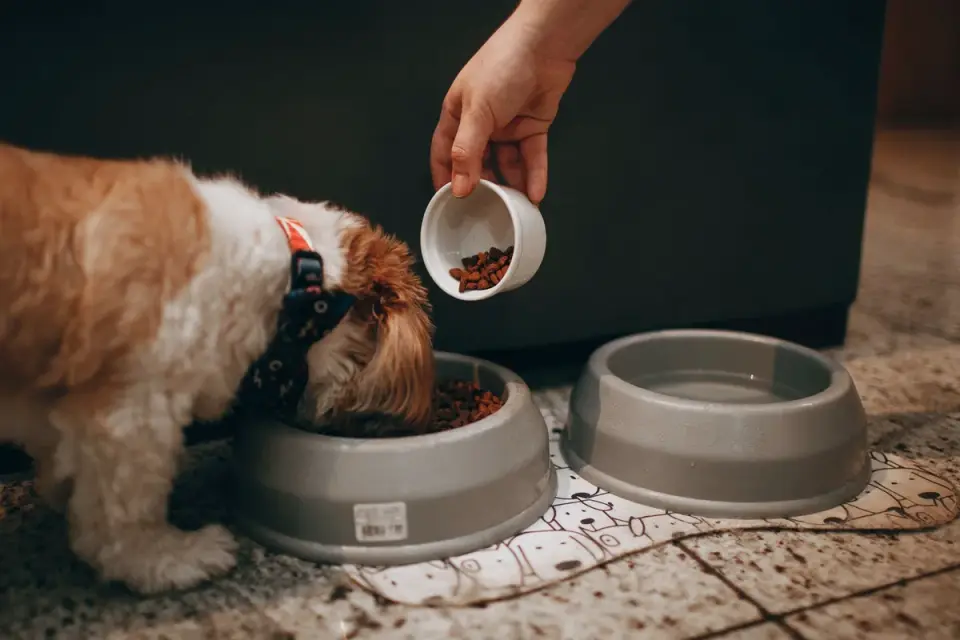
- Hand-feed if nausea is an issue, and keep water bowls low and close to resting spots so the dog isn’t navigating a long, wobbly trip for basics.
- Watch weight during the recovery window. A dog who’s less active for two to three weeks can pack on pounds fast, and extra weight is its own drag on the joints and on general mobility once the vestibular episode resolves.
This is also where owners start asking about where supplements fit — not as a substitute for the vet visit or the recovery timeline, but as part of the broader picture of joint comfort and cellular support for an aging dog who’s already dealing with arthritis or general stiffness on top of a vestibular scare. Antioxidant ingredients such as quercetin and resveratrol are studied for immune and cellular support in aging dogs, but none of that treats a vestibular episode or a stroke — at best it’s a structure/function layer for the joints and general aging picture underneath, never a fix for an acute neurologic event. For a broader look at what’s actually defensible in this category, our guide to senior dog vitamins walks through what the evidence supports versus what’s marketing.
If your dog is already stiffer than usual apart from any vestibular episode, it’s worth reading about how cold weather can make a senior dog seem more stiff and slow than usual, since the two issues — balance and joint comfort — often get tangled together by owners describing “she just seems off lately.” And because a vestibular scare often overlaps with a run of other aging changes, our piece on supplements to support a senior dog’s immune system covers the broader picture beyond just balance.
Where this leaves you
I’ve sat with enough of these cases now to trust the pattern more than the panic. In my experience, the dog who’s still wagging, still eating from your hand, still trying to stand back up even while tumbling sideways, is very often going to be substantially better in two to three weeks — and that’s borne out by what the literature on idiopathic vestibular disease shows about recovery timelines. The dog with a droopy face, a limb that won’t cooperate, or a mind that seems genuinely absent is the one I want in front of a neurologist that day, not tomorrow. According to AKC, sudden vestibular signs in dogs are common enough, and recoverable enough, that they shouldn’t automatically be treated as a worst-case scenario — but they should always be treated as an urgent one, because you can’t tell the difference from the couch.
If muscle loss and general strength are part of what you’re watching during a slow recovery, our guide on whether dog muscle supplements actually rebuild strength, or just slow the loss is a useful next read.
The two-minute checklist to leave with:
- Sudden onset, head tilt, eye flicking, dog still “there” mentally → call your vet today, expect improvement within 72 hours.
- Facial droop, limb weakness, loss of housetraining, or a dazed dog → treat as urgent, imaging may be needed.
- No improvement after 72 hours, or new symptoms appear → back to the vet, don’t wait out the full two-week window.
- Traction, low water bowls, gated stairs, and hand-feeding if needed — set the house up before you need it, not after.
- Supplements support the joints and general aging picture; they are not a treatment for an acute vestibular episode or a stroke.
Frequently asked questions
Can a sudden head tilt in an old dog really just go away on its own?
Often, yes — idiopathic vestibular disease typically starts improving within 72 hours and most dogs are close to normal within two to three weeks, though a mild residual head tilt can persist ([VCA Hospitals](https://vcahospitals.com/know-your-pet/vestibular-disease-in-dogs)). That said, the same signs need a same-day vet check first to rule out a stroke, ear infection, or tumor.
What's the biggest red flag that it's more than vestibular disease?
A dog who seems mentally dulled, has a drooping face, drags a limb, or loses bladder control — those point toward a central or vascular problem rather than simple inner-ear vestibular disease, according to [AKC](https://www.akc.org/expert-advice/health/vestibular-disease-in-dogs/).
Do supplements help during a vestibular episode?
Not for the acute event itself. Antioxidant ingredients like quercetin and resveratrol are studied for cellular and immune support and may fit into a senior dog's broader joint and aging picture, but they aren't a treatment for vestibular disease or stroke.