
On this page
- Watermelon Quick-Check: What to Confirm Before You Cut a Slice
- What’s Actually in a Slice of Watermelon
- Seeds, Rind, and the Blockage Risk Owners Underestimate
- Portioning Watermelon Around Weight and Joint Load
- Dogs Who Should Skip It or Get a Smaller Piece
- Where Watermelon Fits Alongside Movement and Diet
Picture a golden retriever stretched out on a shaded porch in July, her hips already a little stiff from early arthritis, while her owner slices watermelon at the picnic table twenty feet away. The dog perks up at the smell of the cut fruit, tail thumping the boards, and the owner tosses over a chunk without much thought beyond “it’s just fruit, it’s fine.” That instinct is not wrong, exactly, but it skips a question I think owners of dogs carrying extra weight or joint strain should be asking: is this treat actually doing anything useful for my dog, or is it just sugar and water dressed up as a health food? Watermelon is not a superfood and it is not a hazard either. It sits in a narrower lane than most owners assume, and where it lands for your dog depends on body condition, gut sensitivity, and how the rest of the day’s calories are already spoken for.
Watermelon Quick-Check: What to Confirm Before You Cut a Slice
- Confirm every seed is removed, or use a seedless variety and still check
- Cut away all of the rind, including the tough white layer next to the flesh
- Cube the flesh to a size your dog can chew, smaller for small-breed dogs
- Treat it as an occasional add-on, not a daily snack or meal replacement
- Go slow the first time and check stool quality the next day
- Ask your veterinarian first if your dog has diabetes, is overweight, or has a history of a sensitive gut
Each of those points earns a longer look below, because “can dogs eat watermelon” is really three separate questions: what’s in it, what parts are risky, and how much actually makes sense for your dog.
What’s Actually in a Slice of Watermelon
Watermelon flesh is about 91% water, which is the honest source of most of its appeal as a hot-weather treat. It is low in calories per bite and does carry some vitamins and antioxidants along with that water. What it does not carry much of is fiber. A typical serving has well under a gram of fiber, making it one of the lower-fiber fruits available, while its carbohydrate content is almost entirely sugar. That combination, high water and sugar, low fiber, is why I’d frame watermelon as a hydration treat first and a nutritional contributor a distant second. It is not the ingredient I would reach for if a dog’s actual goal is more fiber or steadier digestion.
Seeds, Rind, and the Blockage Risk Owners Underestimate
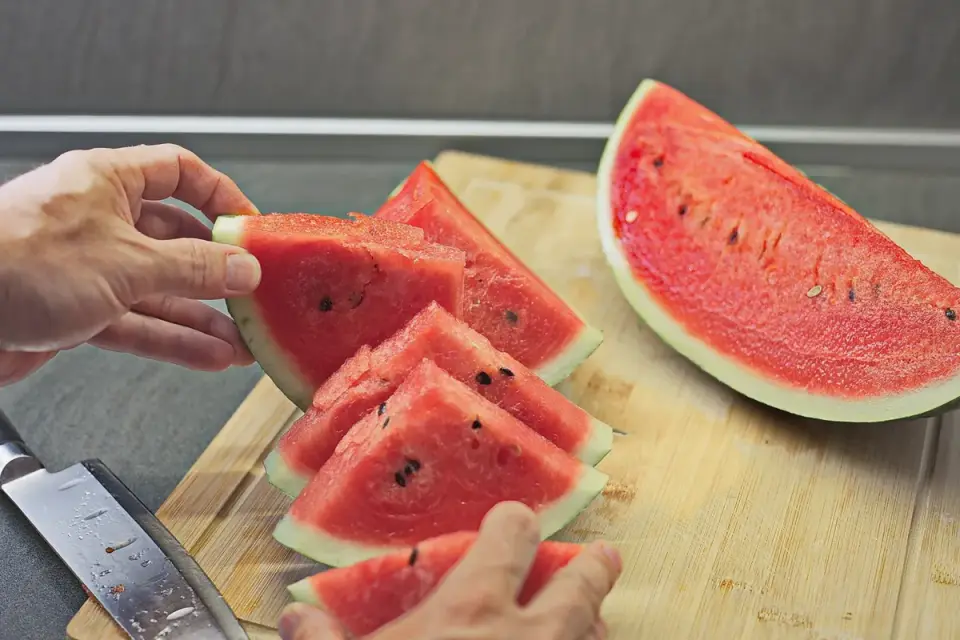
A Labrador puppy at the edge of a garden, still mouthy and unsupervised for a minute too long, grabbing a discarded watermelon rind off a picnic table and swallowing a chunk before anyone notices, is not a rare scenario. The rind is fibrous and dense in a way most dogs cannot break down, and it is a genuine choking and intestinal blockage risk, not a theoretical one. PetMD notes that seeds carry a similar risk, particularly for smaller dogs, since even a small number swallowed whole can contribute to a blockage. VCA Animal Hospitals lists seedless, rind-free watermelon among the foods dogs can safely enjoy, which tells you the exclusion of seeds and rind is not optional caution, it is the actual safety line. If a puppy or an enthusiastic eater does get into rind unsupervised and seems uncomfortable, vomits, or won’t pass stool normally, that warrants a call to your vet rather than a wait-and-see approach.
Portioning Watermelon Around Weight and Joint Load
This is where I land firmly on one side of an argument I hear a version of often: that any fruit is a “healthy” swap for a commercial treat. For a lean, active dog, an occasional small piece of watermelon changes little. For a dog already overweight, or one managing osteoarthritis where every extra pound translates into more force through a hip or a knee, treats need to earn their calories, and watermelon’s Cleveland Clinic: nutrition profile is mostly sugar water with a trace of fiber. That doesn’t make it off-limits. It makes it a treat to weigh against the day’s total calorie budget, the same as any other, and to keep genuinely occasional rather than a daily habit. The counterargument, that a little natural sugar is harmless compared to processed treats, has some truth to it in isolated amounts. But repeated small excesses are exactly how extra weight accumulates quietly in dogs whose joints can least afford it, which is why I’d rather see watermelon used sparingly and purposefully than as a default snack.
Dogs Who Should Skip It or Get a Smaller Piece
Dogs with diabetes should generally avoid watermelon or have it cleared by their veterinarian first, given its sugar content. Dogs with a history of pancreatitis or a sensitive gastrointestinal tract are more likely to react to a new, sugary food with loose stool, so a smaller first portion and a close watch the next day is the sensible approach; our guide on firming up a puppy’s loose stool naturally covers what a normal versus concerning response looks like. Overweight dogs and dogs managing joint disease are not excluded outright, but they’re the group where portion discipline matters most, similar to how we’d approach sweet potato as an occasional add-in rather than a diet staple.
Where Watermelon Fits Alongside Movement and Diet
A treat like watermelon is a small piece of a much larger picture that includes daily movement, weight management, and a home environment that supports a dog’s joints. On hot days it can double as a cooling gesture; see our notes on cooling options for a thick-coated breed at home for lower-calorie ways to help a dog beat the heat. And for senior dogs whose stiffness seems to shift with the weather, it’s worth reading how we think about cold weather and a senior dog’s mobility, since diet is only one lever among several. Watermelon isn’t going to move that needle much on its own. It’s a treat, and treats should support the plan, not compete with it.
Bottom line: seeded, rind-free watermelon in small, occasional amounts is a reasonable warm-weather treat for most dogs, but it’s a hydration snack, not a fiber or nutrition workhorse, so let your dog’s weight and joint health, not the fruit aisle, set the portion.
Frequently asked questions
Can dogs eat watermelon seeds?
Not on purpose. Watermelon seeds are not toxic, but they are hard for dogs to digest and can contribute to an intestinal blockage, particularly in small breeds or if a dog swallows more than a couple, according to PetMD.
Is watermelon rind safe for dogs?
No. The rind is tough and fibrous in a way a dog's gut cannot easily break down, and it is a recognized choking and blockage risk, so it should always be cut away before a dog gets any watermelon.
How much watermelon can a dog eat safely?
Small, seeded, rind-free cubes offered occasionally are the safer pattern. Because watermelon is mostly sugar and water with very little fiber, treating it like an everyday snack rather than an occasional one is where most owners overdo it.
Can watermelon cause diarrhea in dogs?
It can, especially in dogs unaccustomed to it or those with a sensitive gastrointestinal history. Any new food introduced in a large amount, watermelon included, can trigger loose stool, so start with a small piece and watch the next day.
Sources
- Can Dogs Eat Watermelon? Benefits and Risks — PetMD
- Dog Treats — VCA Animal Hospitals
- Watermelon: Nutrition and Health Benefits — Cleveland Clinic