
On this page
Every few weeks a client brings me a dog who is “bored,” and I ask them to describe what that boredom actually looks like at 6 p.m. on a Tuesday. The answers split cleanly into two camps. Some dogs are gnawing the corner of the couch, working their jaw against anything with resistance. Others are pawing at cabinet doors, nosing under the rug, hunting for something that isn’t there. Those are not the same dog, and they don’t need the same toy.
I trained as a neurologist before I ever thought seriously about behavior, and one habit from that training has stuck with me: before you treat a sign, you localize it. A dog who chews is telling you something about oral-motor drive, jaw fatigue, and a need to bite down on something that pushes back. A dog who noses through a puzzle feeder is telling you something about foraging drive and the brain’s appetite for a solvable problem. Reach for the wrong tool and you get a dog who is occupied but still unsatisfied — jaw tired, mind still idling, or the reverse.
The disputed premise: are chewing and puzzle-solving interchangeable
Plenty of pet product marketing treats “enrichment toy” as one bucket — anything that keeps a dog busy for twenty minutes counts. I don’t buy that, and the evidence on shelter dogs doesn’t support it either. A study published in the Journal of the American Veterinary Medical Association tested a program that paired twice-daily cage-behavior training with daily provision of a food-filled toy, and found the combination improved desirable behaviors in kenneled dogs — not chewing alone, not training alone, the pairing. That’s the first crack in the “any toy will do” premise: the toys that changed behavior were doing a specific job, filled and worked for food, not simply gnawed.
The counterargument I hear most from owners is that their dog just wants to chew, full stop, and a puzzle toy gets ignored within a day. That’s often true, and it isn’t a failure of the dog. Chewing is a fixed action pattern with its own reward circuitry — it doesn’t require problem-solving, and for some dogs that’s exactly the point after a long day. I don’t dismiss that. But I also don’t let “he just chews” become the whole enrichment plan for a dog who is pacing, whining at the door, or shredding things that aren’t chew toys, because that pattern usually points to unmet foraging or cognitive drive, not jaw fatigue.
What a chew toy is actually doing
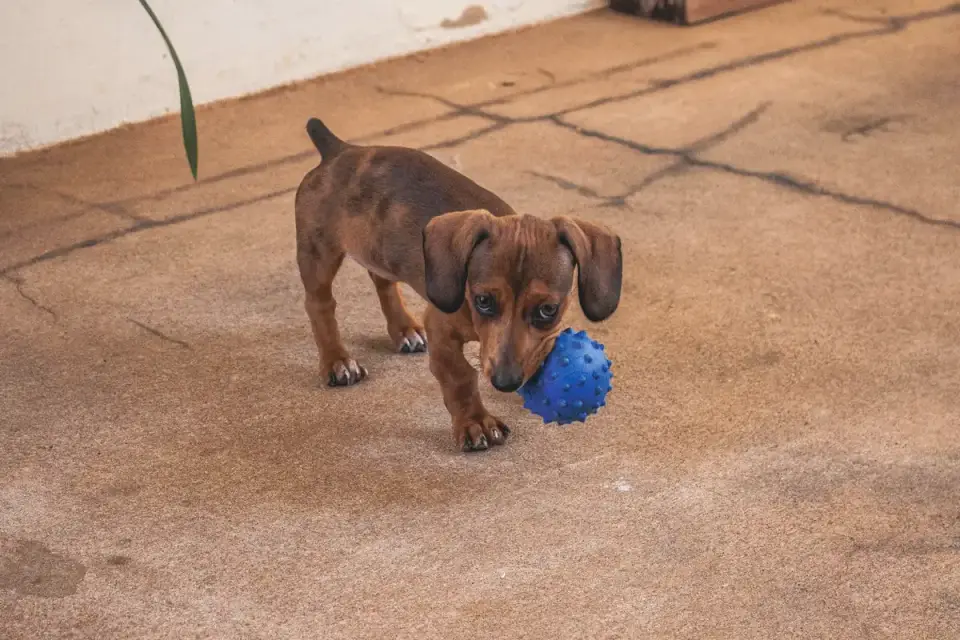
Chewing exercises the jaw, and according to the American Kennel Club, it also relieves the discomfort of teething, works the jaw muscles, and helps clean the teeth as the dog gnaws. Non-edible rubber or nylon chews in particular can help remove plaque as your dog works them, though they are not a substitute for brushing or professional cleanings. The behavioral piece matters as much as the dental piece: chewing is self-soothing. It’s why a dog left alone with nothing appropriate to chew will often improvise on a shoe or a baseboard — the drive to gnaw doesn’t disappear because you didn’t provide an outlet for it.
Where chew toys fall short is cognitive load. A dog can gnaw a nylon bone for forty minutes without engaging much of the problem-solving circuitry that gets taxed by, say, tracking a scent or working out how to tip a container. If your dog’s boredom looks like restlessness and searching rather than tension in the jaw, a chew alone often won’t touch it.
What a puzzle toy is actually doing
Puzzle toys ask something different: sniffing, nosing, pawing, and sequential problem-solving in pursuit of a food reward. That combination of sniffing, licking, chewing, and movement toward a goal is part of why organizations like the ASPCA frame regular enrichment, including puzzle feeding, as a way to let dogs express innate foraging and scavenging behaviors that a bowl-fed routine simply doesn’t call on. In my own caseload, the dogs who respond best to puzzle feeders tend to be the ones whose “bad behavior” reads as searching — digging in the yard, working cabinet latches, following scent trails around the kitchen. Give that dog a job that channels the same drive and a lot of the destructive searching quiets down within days.
The tradeoff is tolerance. Puzzle toys demand patience, and a frustrated dog can disengage fast, especially an older dog with less patience for a slow payoff or a young dog who hasn’t learned that persistence pays. I’ve had owners give up on a puzzle feeder after one failed attempt and conclude their dog “isn’t food motivated,” when the real issue was a puzzle pitched two difficulty levels above where the dog was starting.
I worked with a seven-year-old Labrador named Duke last spring — sixty-eight pounds, mildly overweight, whose owner described him as “just bored and destructive” after she went back to working in an office three days a week. He’d started counter-surfing and pulling books off a low shelf, always between four and six in the afternoon, always on the same hardwood stretch by the kitchen. When I asked what he did with a chew toy, she said he’d mouth it for a minute and drop it. That told me this wasn’t primarily an oral-motor itch — it was foraging drive with nowhere to go during the exact window his walk used to happen. We built a frozen food-puzzle routine timed to that afternoon window, alongside a shorter midday walk to take the edge off before the search drive kicked in. Within about three weeks, the counter-surfing had dropped off almost entirely; the chew toys stayed in rotation for evenings, when he was winding down rather than searching.
Matching the tool to the dog, not the marketing
A few questions I ask before recommending either category:
- What does the “bored” behavior actually look like — gnawing and mouthing, or pacing, digging, and searching?
- Is the dog food-motivated enough to work for a slow payoff, or will frustration end the session in under a minute?
- Is this a puppy in an active teething window, where jaw relief is the priority regardless of cognitive load?
- Does the dog have any dental disease, worn teeth, or jaw pain that makes hard chewing something to scale back, not encourage?
- Is boredom clustered at a specific time of day, and can the toy be timed to that window rather than left out all day?
- Is the household treating one toy as the whole enrichment plan, when movement and structured attention are doing most of the real work?
For most dogs I see, the honest answer is both categories earn a place, on different shifts. A chew toy for the wind-down hours when a dog needs something to gnaw on the couch beside you. A puzzle feeder for the window when the house is quiet and the dog’s search drive has nowhere else to go — sometimes swapped in for part of a meal rather than added as an extra. Neither replaces a walk, and neither should be the only thing standing between a dog and a bad afternoon; see our guide on why your dog won’t settle in the evening for how movement and routine interact with this same restlessness. If you’re unsure whether what you’re seeing is boredom or something closer to distress when you leave, it’s worth reading Boredom vs Separation Anxiety: How to Tell the Difference before you invest in either toy category.
For senior dogs or dogs with joint limitations, I’d also point owners toward how they’re managing supplement routines around the same daily structure — see Chew vs Powder vs Liquid Supplements for Dogs: Which Form Is Most Effective if a joint or mobility supplement is part of the plan, since pairing the right toy with the right supplement delivery format is often what actually sticks as a routine.
Owner checklist
- Watch your dog’s actual boredom behavior for a week before buying anything — gnawing versus searching points to different toys.
- Start puzzle feeders easy; a dog who “fails” the first attempt usually needs an easier version, not a verdict that puzzles don’t work.
- Rotate chew toys and puzzle feeders rather than leaving one out permanently — novelty is part of what makes either one effective.
- Time the toy to the trouble window. A puzzle feeder left out at 7 a.m. does nothing for a dog who unravels at 5 p.m.
- Treat toys as one piece of the picture alongside walks, weight, and — where relevant — how a joint supplement is delivered, not a stand-alone fix.
- Talk to your veterinarian before introducing hard chews if your dog has existing dental disease or a history of tooth fracture.
Owners who get this right usually aren’t the ones who found the “best” toy — they’re the ones who kept watching their dog long enough to notice which kind of bored they were actually looking at, and adjusted the routine as the dog aged or the season changed.
Frequently asked questions
Should I give my dog a chew toy or a puzzle toy first?
Watch the behavior you're trying to solve. Gnawing, mouthing, and jaw-focused restlessness usually respond better to a chew toy; pacing, digging, and searching behaviors usually respond better to a puzzle feeder that channels foraging drive.
Can puzzle toys replace a walk?
No. Puzzle toys add mental engagement, but they don't substitute for the physical movement and outdoor exposure a walk provides.
My dog ignores puzzle toys — what's wrong?
Often the puzzle is too hard for a first attempt. Start with an easy version that pays off quickly, then increase difficulty once your dog understands the game.
Sources
- Effects of environmental enrichment on the behavior of shelter dogs — Journal of the American Veterinary Medical Association
- Choosing the Right Dog Toys and Teething Toys for Your Puppy — American Kennel Club
- Canine DIY Enrichment — ASPCA