On this page
I still think about Willow, a twelve-year-old Cavalier King Charles Spaniel who came home from a partial cruciate repair on a Thursday, sound asleep on a heating pad, wrapped in a blanket that smelled like the clinic. Her owners had already bought a playpen — tall, wire, the kind sold for puppies — because it looked kinder than a crate. By Saturday, Willow was pacing its four-foot diameter, turning tight circles, occasionally rearing up on her hind legs to look over the top. Nobody had done anything wrong on purpose. They had just picked the setup that felt gentle instead of the one that was actually correct for a dog eight days into ligament healing.
That gap between what feels kind and what actually protects a healing joint is where most owners get this decision wrong, and it’s worth slowing down on before you buy anything.
What “rest” is actually asking of the space
Strict rest after orthopedic surgery or a flare of disc disease isn’t really about keeping a dog calm. It’s about physically preventing the exact movements that damage soft tissue or implants while they heal: jumping, twisting, sudden extension, unsupervised stairs. The VCA Animal Hospitals explains exercise restriction as intentionally limiting a pet’s activity so the body has time to heal, and notes that dogs recovering from surgery are often confined to a crate or small room specifically to minimize movement your dog could otherwise perform on their own. That distinction matters more than comfort does in the first stretch of recovery. A dog who feels good, as many do within days of surgery, will act on that feeling long before the tissue underneath is ready.
For cranial cruciate ligament repairs specifically, the American College of Veterinary Surgeons notes on its page on Cranial Cruciate Ligament Disease that activity must be restricted for weeks after surgery to avoid complications with implants or healing, with dogs kept on a short leash and never allowed to run, jump, or play during that window. None of the three setups we’re comparing here are interchangeable once you understand what the restriction is actually protecting against.
Where a crate does its best work
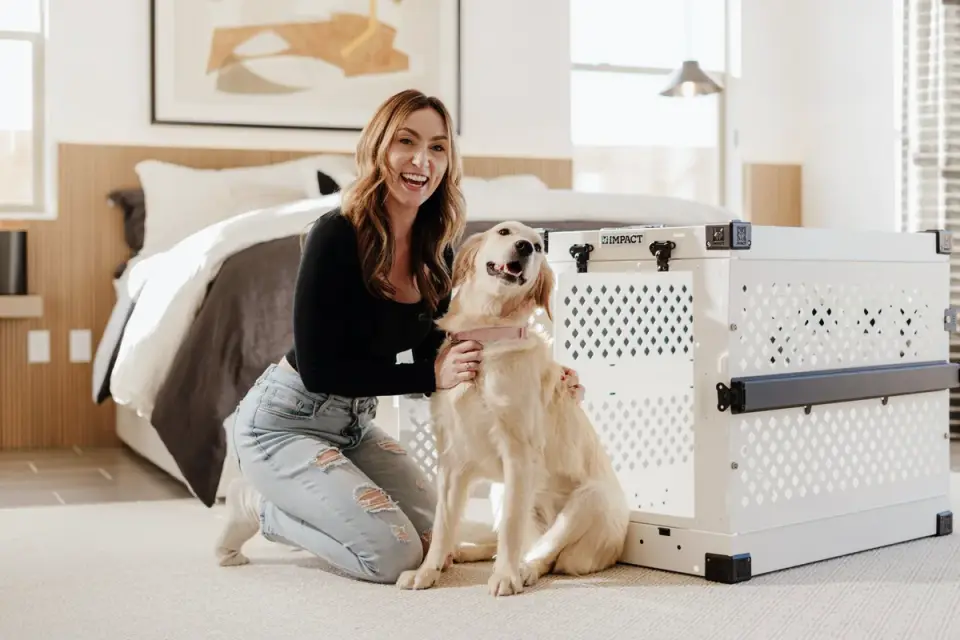
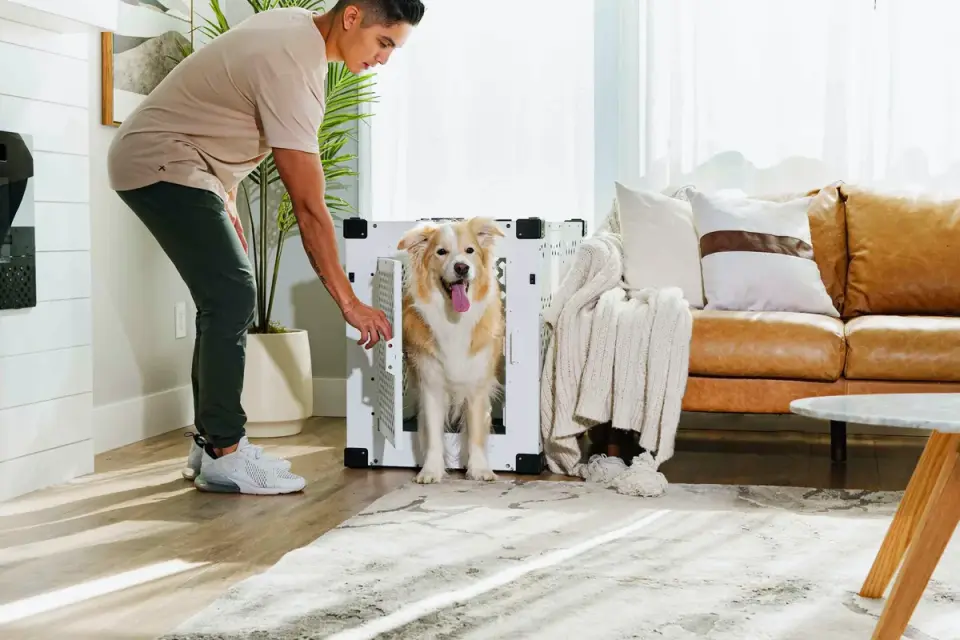
A crate is the only one of the three options that removes the option to jump, spin, or startle-run entirely. If it’s sized so the dog can lie fully stretched, turn, and stand without ducking, it becomes a small, predictable box the dog can’t undo their own surgery inside. That’s precisely why crate confinement is the default recommendation after most orthopedic procedures and for many spinal cases. It isn’t a punishment; it’s the tool with the narrowest failure mode.
The tradeoff is real, though. A dog who has never been crate-trained, or one who is anxious in confinement, can pace, whine, or self-traumatize against the door, which sometimes does more harm than the freedom it was meant to prevent. Preventive Vet’s guide on How to Survive Crate Rest with an Energetic Dog is a useful reality check here — it walks through exactly the frustration owners hit around day three or four, when the dog feels fine and the crate starts to feel like the enemy.
Where a playpen earns its keep
Playpens solve a different problem: they give a dog room to shift position, stretch, and rest in more than one spot, which matters over weeks-long confinements where a crate can start to feel punishing for both the dog and the family watching them in it. But a standard puppy playpen, four feet across with a low sill, does nothing to stop a motivated dog from rearing up, spinning to greet someone at the door, or clearing the top edge with a running start. If you use one during rest, it needs to be tall enough that jumping isn’t realistic, and it works best for dogs who are naturally low-energy or already several weeks into a slower recovery phase — not for the first, most vulnerable days after surgery. Our guide on Baby Gate vs Playpen for a New Puppy covers the sizing tradeoffs in more detail, even though that piece is written for a different stage of a dog’s life.
When a gated room is the right call
A gated-off room, a laundry room or a small bedroom with the door blocked instead of the dog boxed in, gives the most space of the three, and for dogs who genuinely cannot tolerate confinement, that room to breathe can be the difference between a recovery that goes smoothly and one that spirals into anxiety-driven self-harm. The catch is flooring and furniture. If that room has a bed a dog can leap onto, a slick tile floor that invites a slide-and-catch, or enough square footage for three running steps before a turn, the walls of the room aren’t actually restricting anything that matters. A gated room only works as rest if you’ve also solved for traction and removed every surface a dog could launch from, which is exactly the kind of setup failure our piece on Common Mistakes When Setting Up a Dog Recovery Space walks through room by room.
In my own practice, I’ve watched families choose the gated bedroom option because the crate felt cruel, and for a certain kind of dog — an anxious rescue, an older dog who has never once tolerated being shut in — that was genuinely the right call. I remember a nine-year-old Shepherd mix, recovering from a hemilaminectomy after a disc herniation, whose owners gated off their home office because she’d torn a nail bloody trying to get out of a borrowed crate at the hospital. We laid interlocking rubber mats over the hardwood, moved the desk chair out entirely, and she recovered without a single setback over ten weeks. The room worked because they treated it with the same seriousness as a crate, not because a room is inherently gentler.
What I actually recommend, and why
If I’m being honest about where the evidence and my own years of cases land me: for the first two to four weeks after most orthopedic surgery, a properly sized crate is still the safest default, and I say that knowing it’s the least popular answer with worried owners. The strongest argument against it, that confinement stress can itself slow healing and damage the human-animal bond, is a real one, and I don’t dismiss it. But a stressed dog in a crate is a solvable problem: a snug blanket, a Kong, sometimes a short course of anti-anxiety medication your vet prescribes alongside pain control. A dog who reinjures a repair by clearing a playpen wall is not a solvable problem; it’s a second surgery. Once a dog is a few weeks out and your vet has cleared more freedom, transitioning to a taller playpen or a well-prepared gated room is where I steer most families next, because sustaining strict confinement for the full recommended period is genuinely hard on everyone, and the setup should get a little more livable as the tissue does.
Traction matters just as much as the enclosure you choose, and it’s easy to overlook once the crate or gate is decided. Our room-by-room guide to Floor Traction Setup After Knee Surgery covers the mats, rugs, and pathways that make any of these three options actually safe to use.
A checklist before you set anything up
- Confirm with your vet which restriction level your dog’s specific surgery or condition calls for, and for how many weeks.
- If choosing a crate, size it so your dog can lie fully stretched, sit upright, and turn without ducking.
- If choosing a playpen, use it only once your vet has approved more freedom, and pick a wall height a standing dog can’t clear.
- If choosing a gated room, remove every surface a dog could jump onto or off of, and add non-slip flooring throughout.
- Plan for the emotional toll of confinement before day three, not after; a bored, anxious dog is often what breaks the setup, not the setup itself.
None of these three is the universally kind choice or the universally correct one. The kindest thing you can do for a dog on rest is match the enclosure to what their specific healing actually requires, and adjust as your vet tells you they’re ready for more.
Frequently asked questions
Is a playpen ever safe during the first week after surgery?
Usually not on its own. Most standard playpens are short enough for a motivated dog to clear, and the first one to two weeks after orthopedic surgery are when a single bad jump does the most damage. A crate, or a gated room with jump-proofing already done, is the safer default until your vet clears more freedom.
How do I know if my dog's crate is the right size for rest?
Your dog should be able to lie fully stretched out, sit upright without their head touching the top, and turn around without stepping over their own limbs. Too small adds stress; too large defeats the purpose by giving room to build up momentum.
My dog panics in a crate. What are my other options?
A gated room can work well for a dog who truly cannot tolerate confinement, but it isn't a shortcut — you still have to remove every surface they could jump onto or off of and add non-slip flooring. Talk to your vet about short-term anti-anxiety support as well; a calmer dog in a crate is often safer than an anxious one with more room to move.
Sources
- Exercise Restriction in Dogs — VCA Animal Hospitals
- Cranial Cruciate Ligament Disease (CCL) — American College of Veterinary Surgeons
- How to Survive Crate Rest with an Energetic Dog — Preventive Vet