On this page
I get some version of this question at almost every goldendoodle puppy visit: “She’s not going to shed, right? That’s the whole point of a doodle.” I understand why owners believe it — the marketing around doodle breeds has leaned hard on “hypoallergenic” and “non-shedding” for two decades. But I’ve examined enough goldendoodles that shed noticeably, sitting next to littermates that barely do, to know the premise needs testing before I’ll repeat it to a client.
Here’s the disputed premise, stated plainly: goldendoodles don’t shed. It’s not true across the board, and treating it as true sets owners up to feel misled by month six, right around when the puppy coat starts blowing out and a client calls asking if something is medically wrong with their dog.
What actually decides whether a goldendoodle sheds
Shedding in goldendoodles comes down to a specific genetic trait called furnishings — the gene responsible for the mustache, beard, and eyebrows you see on a scruffy-faced doodle. According to the Goldendoodle Association of North America, furnishings are what confer the low- to non-shedding coat, and neither the curl gene nor coat pattern itself reliably predicts shedding on their own. A dog can be wavy, curly, or straight-coated and still land anywhere on the shedding spectrum, because furnishings status — not curl — is doing most of the work.
Puppies with two copies of the furnishings gene tend to be non-shedding or close to it. One copy usually means low-shedding, still noticeable, still leaving hair on dark furniture, just less than a Golden Retriever. Zero copies produces what breeders call an “unfurnished” or “improper” coat: flat, close to the Golden Retriever’s own coat, and it sheds like one. GANA’s breed standard describes this flat-coated variety directly as the shedding phenotype within the breed, not an outlier.
There’s a genetic test for this now, and it matters more than a breeder’s word or a puppy’s early appearance. A wavy 8-week-old puppy can still mature into a heavier shedder if it only carries a single copy of furnishings, or none. If shedding is a genuine priority — allergies in the house, a no-fur-on-the-couch rule — ask the breeder for the furnishings genotype of both parents and the litter, not just a photo of a curly coat.

The counterargument, and why I still land where I do
The strongest pushback I hear from breeders is that even unfurnished or lightly-furnished doodles shed less than a purebred Golden Retriever because of the Poodle influence in the cross, and that’s fair — a first-generation goldendoodle with one furnishings copy is very likely to shed less than either purebred parent on average. I’m not disputing that doodles, as a category, trend lower-shed than many single-breed retrievers. What I push back on is the flat claim that the breed itself guarantees a non-shedding, allergy-friendly dog. That’s a coat-genetics outcome for some individual dogs, not a breed guarantee, and conflating the two is what leaves owners blindsided.
A grooming routine that works regardless of coat type
I tell clients to build the routine around the coat they actually have, checked at around 10–12 weeks and again after the puppy coat starts to shift around six months, rather than the coat they were promised.
- Furnished, wavy or curly coats: brush two to three times a week with a slicker brush down to the skin, not just over the top layer, to prevent matting. These coats don’t shed onto the floor much, but the loose hair has to go somewhere — usually into mats near the ears, armpits, and collar line if it’s skipped.
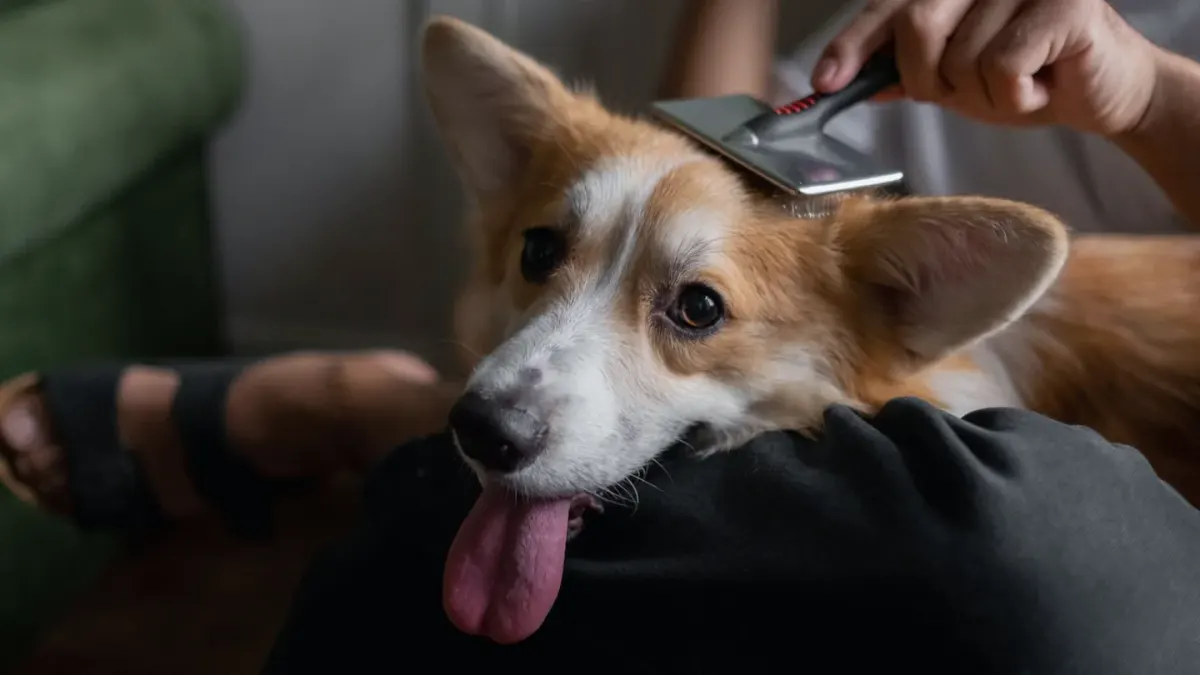
- Lightly furnished or flat coats: treat it like a double-coated shedding breed. The American Kennel Club recommends brushing double-coated dogs several times a week, more often during seasonal shedding, using a de-shedding tool for the undercoat plus a finishing brush.
- Every coat type, every 6–8 weeks: a professional groom or a thorough bath and blow-out at home to lift dead hair before it mats or scatters around the house.
- Year-round, regardless of coat: a quick daily hand-check of ears, feet, and the collar area takes under a minute and catches early mats before they need to be shaved out.
One dog I worked with, a two-year-old goldendoodle named Wrigley, around 55 pounds, came in because his owner was convinced something was wrong — he was leaving visible tufts of hair on the kitchen tile every morning, which she’d been told doodles simply don’t do. His coat was wavy, not flat, so on appearance alone he looked like a “correct” low-shed dog. But his coat panel, run after the visit at the owner’s request, showed only one copy of furnishings. He wasn’t sick. He was doing exactly what a single-furnishings-copy dog does — shedding measurably more than his sister from the same litter, who carried two copies and left almost nothing on the floor. Once the owner understood the genetics, the anxiety about his health resolved, and we just adjusted his brushing schedule to match a lower-furnished coat instead of the curly-coat routine she’d been using.

Where the whole picture fits together
Coat care doesn’t happen in isolation from the rest of a goldendoodle’s health, and I’d rather owners think about it that way from the start. A dog that’s regularly brushed and mat-free moves more comfortably — mats near the elbows, hips, and between the toes can genuinely restrict a dog’s gait and make owners assume it’s a joint issue when it’s actually a grooming issue. If you’re also setting up a recovery or rest space for an older or post-surgical doodle, it’s worth reading through common mistakes when setting up a dog recovery space alongside your grooming routine, since matted fur and a recovery mat surface don’t mix well. And because goldendoodles — furnished or not — carry a moderate coat that traps heat, owners in warmer climates should look at cooling options for a thick-coated breed at home before peak summer, not after the dog is already panting heavily on walks.
For anyone bringing home a doodle puppy for the first time, the groundwork matters as much as the coat genetics. Getting the crate setup for a puppy’s first night right, and understanding what a first year of rapid growth and coat change actually looks like the way it’s laid out in what to expect in a Labrador puppy’s first year, gives owners a realistic baseline instead of a marketing one — even though that piece is Labrador-specific, the growth-plate and exercise pacing principles apply to a goldendoodle’s frame too.
In my practice, the owners who do best with a doodle aren’t the ones who picked the breed because they were promised zero shedding. They’re the ones who understood, going in, that they were picking a coat-genetics lottery with better odds than a straight retriever cross, and who built a brushing habit around whatever ticket they actually drew. That’s a more honest sales pitch than “non-shedding,” and it holds up a year later when the client is back in my exam room, not frustrated, just brushing a dog whose coat they finally understand.
Before you commit: a quick owner checklist
- Ask the breeder for furnishings genotype results on the litter, not just a description of “hypoallergenic” or “non-shedding”
- Expect any goldendoodle, even a heavily furnished one, to need brushing at least twice a week
- Watch for the coat shift around 5–7 months, when puppy fluff gives way to the adult coat and shedding patterns become clearer
- Budget for a groomer every 6–8 weeks regardless of coat type — this is a maintenance cost, not an optional extra
- If allergies are the real driver of your decision, talk to your own allergist about a trial visit with the specific dog, since furnishings reduce shed hair but don’t eliminate dander
So is a shedding goldendoodle actually a “bad” one, or just an honestly-coated dog wearing a name that oversold the whole litter?
Frequently asked questions
Do all goldendoodles shed the same amount?
No. Shedding depends primarily on the furnishings gene rather than on coat curl, so littermates can shed very differently depending on how many copies of that gene each puppy inherited.
Is a flat-coated goldendoodle less "correct" than a curly one?
It's a recognized coat variant, but it's the one most associated with noticeable shedding, closer to a Golden Retriever's coat than to a furnished, low-shed doodle.
How can I find out what coat my puppy will end up with?
A furnishings genetic test on the puppy or its parents is more reliable than judging by early appearance, since coat texture can still shift as the dog matures.
Sources
- Goldendoodle Appearance — Goldendoodle Association of North America
- Dog Shedding: When Dogs Shed Most and How to Manage It — American Kennel Club