On this page
The dogs that stay moving longest are rarely the toughest — they’re the ones whose owners learned to dose movement like medicine. My disputed premise for stiff seniors is this: rest does not protect joints, but unmeasured exercise does not build them either. What helps is a deliberate ramp of low-impact movement, body weight control through food therapy, and joint nutrition weighed for what it can realistically do for diet, mobility, and recovery.
I saw that tension in a 12-year-old, 58-pound mixed-breed dog whose owner had cut walks to a quick curb break because evenings looked painful. For three weeks in, the pattern was familiar: slow to rise for the first minute, then willing once warm, then sore that night after a long Saturday outing. The owner worried more movement would cause harm and less movement would let muscle fade, and both concerns held truth. We mapped a baseline of two eight-minute leash walks per day and tracked next-morning rise time as our decision marker.
Start with the build-up checklist
- Get veterinary clearance first, especially for new lameness, swelling, or behavior change
- Find baseline minutes your dog can repeat for three days without next-day stiffness
- Split movement into two to three short sessions rather than one long outing
- Warm up with 3–5 minutes of slow walking and sniffing before any brisker pace
- Add 10–15% total time per week only if recovery stays clean
- Keep surfaces grippy and level, and favor ramps over stairs and jumps
- Track weight, muscle cover, and morning rise time alongside minutes walked
- Adjust food intake to hold lean condition as activity shifts
That checklist carries the whole plan. The sections below explain the why behind each line and where supplements fit alongside movement.
Why short and frequent builds fitness without flaring stiffness
Cartilage, muscle, and tendon adapt to repeated, moderate loading, not to occasional heroic effort. A stiff senior often warms out of early steps because synovial circulation and soft-tissue extensibility improve with gentle motion, then pays later when duration exceeds tissue tolerance.
Keep early work at a conversational pace where your dog can sniff, shift gaits, and choose footing. Level grass, packed dirt, and carpeted hallways load joints more forgivingly than slick tile or steep hills. If you want variety, alternate a neighborhood loop with a quiet field walk or a controlled indoor session, a rotation I discuss in more depth in off-leash versus on-leash exercise for joints and structured exercise versus dog-park play.
Recovery tells you when to progress.
A clean progression means similar energy on the next walk, no new lagging behind, and morning rising no slower than baseline. If stiffness lasts more than an hour in the morning or carries into the next day, hold at the prior week’s total for another week before trying again.
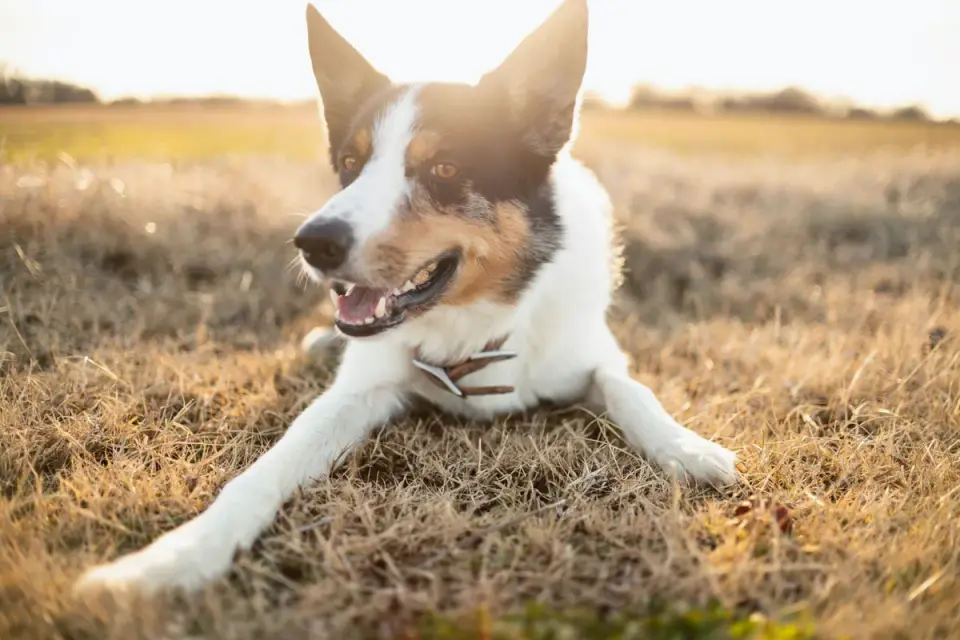
The failed approach I see most often is the weekend catch-up. One owner of a 72-pound senior tried to make up for rainy weekdays with a 45-minute Sunday hike, and by day 10 the dog was planting his front feet at curbs and needing coaxing up two porch steps. Total weekly minutes had not looked excessive on paper, but the dose was concentrated instead of distributed. We cut the long hike, spread the same minutes across five 12-minute walks, added a non-slip runner to the entryway, and morning rise time shortened again within a week. Consistency rebuilt tolerance where intensity had erased it.
Where joint nutrition realistically fits next to movement
Food therapy comes first: lean body condition reduces load with every step, and adequate high-quality protein helps preserve the hind-limb muscle that stabilizes aging hips and stifles. Weigh what a supplement can realistically do for diet, mobility, and recovery, rather than asking it to replace movement or weight care.
Glucosamine and chondroitin are among the most studied joint support ingredients for dogs, and that history is useful context when reading labels. Experimental work reports that glucosamine may “prevent experimentally induced cartilage degradation in vitro,” according to the Journal of Veterinary Medical Science, while chondroitin research describes activity that “supports healthy synovial fluid homeostasis,” according to Frontiers in Veterinary Science. Those are structure and function observations, not promises of pain relief, and they matter most as part of a steady routine alongside exercise.
Green-lipped mussel offers another ingredient-literate example. It contains omega-3 fatty acids and glycosaminoglycans studied for joint support, and laboratory work in rats found that mussel and related marine oils “alleviated paw swelling in rats and reduced serum levels of rheumatoid factor (RF), anti-cyclic citrullinated peptide (anti-CCP) antibody, and pro-inflammatory cytokines such as TNF-α and IL-17,” as reported in Nutrients. That finding does not translate directly to your dog on a walk, but it helps explain why this ingredient appears in mobility formulas intended to support normal joint function with daily use.
The strongest counterargument deserves airtime: some clinicians argue supplements add little once prescription joint care and rehab are in place. I still land on including a well-formulated joint supplement for stiff seniors because the nutritional cost is low, daily feeding supports adherence, and the broader plan — movement, weight, footing — does the heavy lifting while nutrition may help support the joint environment over time.
Make the home setup do half the work
Exercise gains fade fast if your dog slips getting up for dinner. Place non-slip runners on the paths your dog actually uses, from bed to door and door to yard. Raise food and water to elbow height, add a sturdy ramp to the car or favorite couch, and keep nails trimmed so toes can grip.
Cold mornings deserve special handling. Many seniors look stiffer when air temperature drops, a pattern explored in cold weather and senior stiffness. Walk midday when possible, allow a longer warm-up, and consider a light coat for short-coated dogs. For dogs that fatigue quickly on pavement, water walking or careful swimming can complement land work, with tradeoffs outlined in swimming versus walking for an arthritic dog.
The edge case that changed my intake questions involved a 9-year-old, 44-pound dog who moved beautifully on walks yet groaned rising from a deep, soft bed. By week four her walk minutes had doubled without issue, but morning stiffness had not budged until we swapped the sagging bed for a firm orthopedic mat and added a runner beside it. Her observable marker was not lameness on the trail but the three-minute struggle to stand after naps, which shortened to under 30 seconds once footing and bed height changed. Build fitness on the walk, but audit where your dog spends the other 22 hours.
A sample 4-week ramp you can copy
Use your baseline from the checklist, then follow this shape rather than exact minutes. If baseline is 10 minutes twice daily, week two becomes 11–12 minutes twice daily, week three holds or adds a third short outing, and week four adds gentle variety such as a slightly hillier block or five minutes of figure-eight walking on grass for balance. Add five minutes of sniffing, cookie stretches, or slow cavaletti poles over a broom handle on non-walk days only if recovery stays clean.
Stop progression and call your veterinarian if lameness appears at a walk, swelling develops, your dog sits down mid-walk repeatedly, or appetite and demeanor shift.
Owner checklist to keep progress on track
- Log minutes, surface, and next-morning rise quality for two weeks
- Weigh monthly and adjust meals to keep ribs easily felt under light cover
- Keep joint nutrition daily and with food, not only on active days
- Trim nails, manage paw hair between pads, and maintain runners and ramps
- Reassess every 2–3 weeks: hold, progress 10–15%, or step back one level
Steady, measurable movement preserves more independence than any single remedy.
Frequently asked questions
How long should the first walks be for a stiff senior dog?
Start with the duration your dog can repeat for three days without worse stiffness the next morning, often 5–10 minutes twice daily, then add 10–15% per week only if recovery stays clean.
Should I walk my senior dog every day if joints are stiff?
Most stiff seniors do better with short daily movement than with rest followed by one long outing. Split minutes across two to three sessions and hold steady during flare-ups after veterinary guidance.
Do joint supplements replace exercise for stiff joints?
No. Lean weight, consistent low-impact movement, and grippy home footing drive most of the benefit. Joint nutrients like glucosamine, chondroitin, and green-lipped mussel may help support normal joint structure and function alongside that plan.
Sources
- Chondroitin and synovial fluid homeostasis study — Frontiers in Veterinary Science
- Glucosamine and cartilage degradation study — Journal of Veterinary Medical Science
- Green-lipped mussel inflammation study — Nutrients