
On this page
What we mean by cycle reversal
Sleep-wake cycle reversal in senior dogs means your dog sleeps by day and wanders restless at night. It’s a fairly literal description. A dog who used to nap through the afternoon and settle by 9 p.m. starts dozing on and off all day, then paces, pants, or whines once the house goes quiet. Owners often describe it as their dog’s internal clock running backward.
Veterinary behaviorists group this under a broader label: canine cognitive dysfunction, or CCD. VCA Animal Hospitals uses the acronym DISHAA to organize the clinical picture — Disorientation, changes in social Interaction, Sleep-wake cycle changes, loss of House training, altered Activity, and Anxiety. Sleep-wake disruption is its own letter in that acronym because it’s common enough, and disruptive enough, to call out separately. Prevalence climbs steeply with age: a large share of dogs show at least one DISHAA sign by their early teens, and most do by 15 or 16.
It’s worth sitting with that for a second. This isn’t rare.
Why an aging brain flips day and night
Sleep architecture itself changes with age, independent of any disease process. Research summarized in a polysomnographic study of aging dogs found that elderly dogs spend more of the daytime in slow-wave sleep and more of the nighttime simply awake, a near mirror-image of a younger dog’s pattern, according to PMC (National Library of Medicine). The same research links poorer sleep quality to worse performance on cognitive testing, which lines up with what many owners already suspect: the sleep problem and the mental fog seem to move together, not separately.
The leading mechanism behind CCD is progressive accumulation of beta-amyloid protein in the brain, similar in some respects to what happens in human Alzheimer’s disease. That buildup interferes with the circuits that normally keep a dog oriented to time of day. Reduced blood flow and general neuronal aging add to it. None of this is something a dog did wrong, and it isn’t something you missed.
What actually gets ruled out first
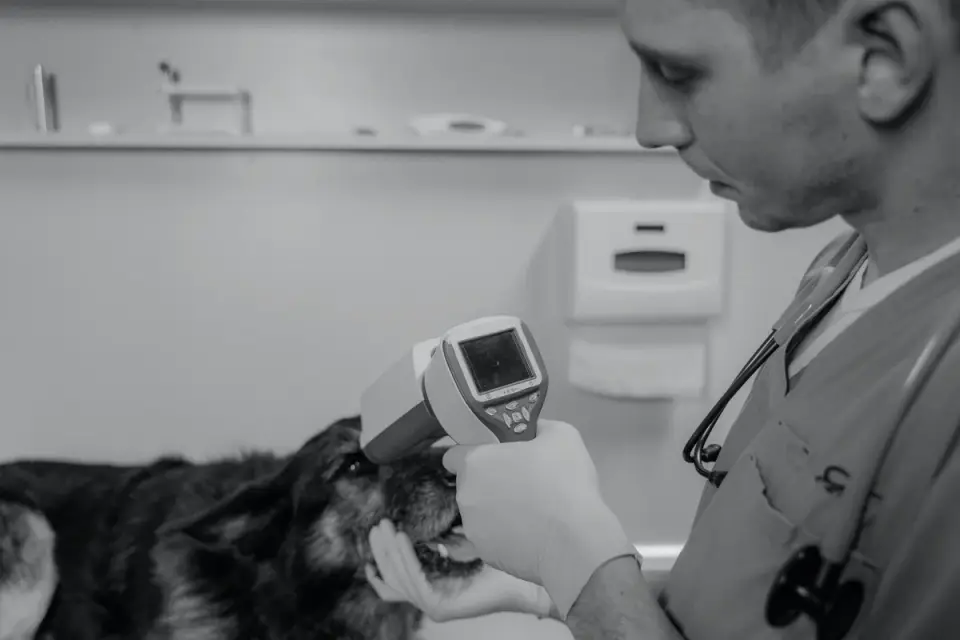
Before you assume it’s cognitive aging, a vet visit matters, and here’s why: several unrelated problems produce the exact same nighttime restlessness. Arthritis pain that flares once a dog lies still. A urinary tract infection or kidney change that has her needing to go out more. Vision or hearing loss that makes a familiar dark room feel disorienting. Even a change in medication timing can shift a dog’s rhythm.
Your vet will likely ask when the change started, whether it’s gradual or sudden, and what else has shifted, then run bloodwork and a physical exam before settling on cognitive dysfunction as the explanation. AAHA frames this the same way in its senior care guidelines: cognitive dysfunction is a diagnosis of exclusion, reached after other medical causes are addressed, not the first assumption. That order matters because pain and CCD are frequently treated very differently.
Owners sometimes notice a parallel shift in how their dog reacts to the world during the day, not just at night — for instance, an old dog startling at sounds he used to ignore can point to the same underlying sensory and cognitive changes worth mentioning at that same vet visit.
What helps once cycle reversal sets in
Once medical causes are ruled out or treated, management is mostly about structure. A predictable daytime routine — set mealtimes, a midday walk, some mental stimulation like a sniff walk or puzzle feeder — helps anchor a confused brain to the actual time of day. Bright natural light in the morning and dimmer, calmer evenings reinforce that same signal.
At night, keep things boring and safe rather than trying to force sleep. A nightlight so your dog isn’t disoriented in total dark, a consistent last-call bathroom break, and a sleep area away from drafts or noise all reduce the odds of a 3 a.m. pacing episode. If you’ve ever built a calm, low-stimulation sleep space for a new puppy’s first night, the same instinct applies here: fewer surprises, more predictability.
That’s a short list, but it’s the one with the most evidence behind it.
Where supplements fit, realistically
Supplements come up constantly in this conversation, and it’s worth being honest about their role: they support, they don’t reverse. None of the ingredients marketed for senior cognitive support turn back the clock on amyloid buildup or brain aging. What they’re studied for is narrower — supporting normal cellular and antioxidant function alongside everything above, not replacing it.
Ask your vet before adding anything, since dose and interactions with other medications matter, and treat any supplement as one line item in a longer routine rather than the fix itself.
So what now?
If your senior dog’s nights have started looking like this, the honest next step is a vet visit, not a product search. Once medical causes are addressed, the routine work — light, structure, a calmer bedroom — tends to do more for a flipped sleep-wake cycle than anything you can buy. What would your dog’s evening look like if the lights, the walk, and the last meal happened at the exact same time every day?
Frequently asked questions
Is sleep-wake cycle reversal the same thing as dog dementia?
It's one sign of canine cognitive dysfunction, not a separate condition. A dog can show disrupted sleep alongside disorientation, house-soiling, or reduced interaction, or it can show up largely on its own early on.
Can a senior dog's flipped sleep schedule be fixed?
It's usually managed rather than fixed. A consistent daytime routine, daylight exposure, and ruling out pain or medical causes can meaningfully reduce nighttime restlessness, even when the underlying brain changes are permanent.
When should I call the vet about my old dog's nighttime waking?
Call sooner rather than later, especially if the pacing, panting, or vocalizing is new. Your vet needs to rule out pain, a urinary issue, or a hearing or vision change before assuming it's cognitive.
Sources
- Behavior Counseling: Senior Pet Cognitive Dysfunction — VCA Animal Hospitals
- Managing Cognitive Dysfunction and Behavioral Anxiety — AAHA
- Sleep and cognition in aging dogs: A polysomnographic study — PMC (National Library of Medicine)