On this page
Here’s the premise I push back on most when owners describe a scuffle in the dog park: that the noise tells you what’s happening. It doesn’t. I’ve had clients call me convinced their dog was “attacked” over a wrestling match that included growling, bared teeth, and a body slam — and I’ve had clients laugh off an interaction that, on closer look, was one dog pinning another against a fence with nowhere to go. Volume and teeth are the least reliable signals in the whole exchange.
What actually separates play from conflict is reciprocity — whether both dogs keep choosing to re-engage, and whether the bigger or stronger dog is willing to lose on purpose. That’s the pattern I look for first, before I even listen to the sound.
What Real Play Actually Looks Like
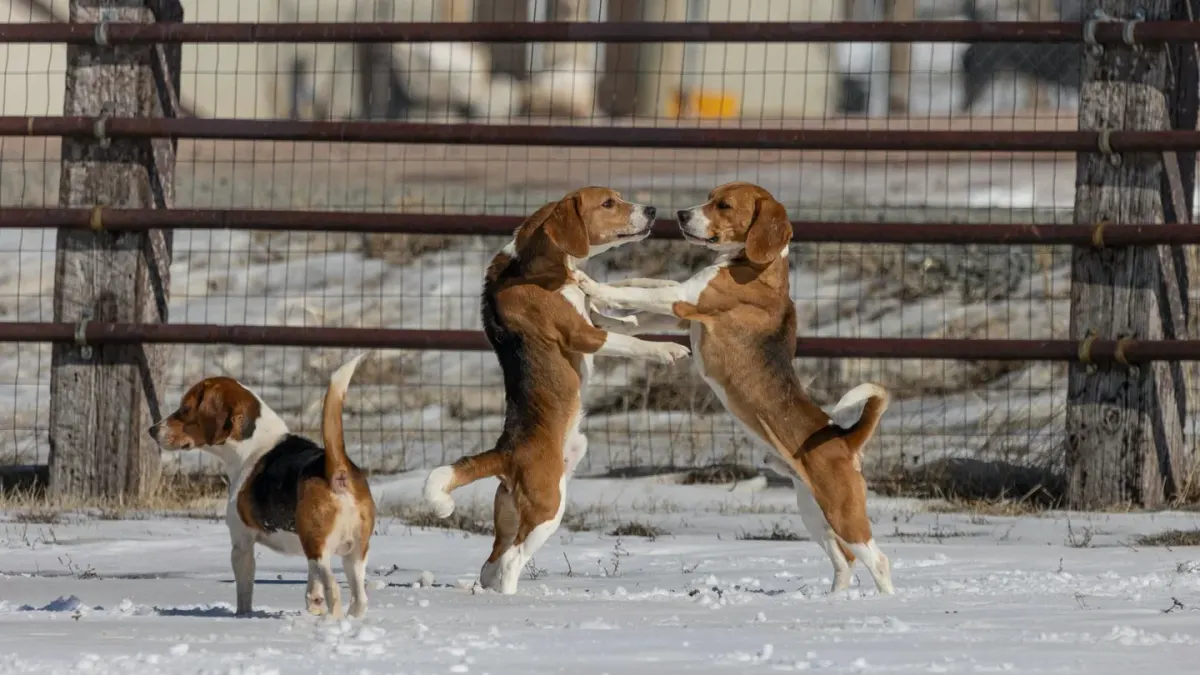
Play between dogs is loud, physical, and often looks rough to a first-time observer — that’s normal. The tell isn’t in any single behavior; it’s in the pattern across the whole interaction.
Real play includes:
- Self-handicapping — a bigger or older dog deliberately holding back, letting a smaller or younger dog win a chase or a wrestling round.
- Role reversal — the dog on top one minute is on the bottom the next, and neither seems bothered by it.
- Play bows — front legs stretched flat, rear end up, sometimes paired with a bark or a bounce, used to say “that was play, let’s keep going.”
- Loose, bouncy movement — a relaxed open mouth, soft eyes, and a body that curves rather than stiffens.
The interruptions matter as much as the action. Dogs playing well will pause on their own, shake off, sniff the ground, then dive back in. That voluntary reset — walking away and coming back — is one of the strongest indicators you’re watching a game and not a conflict.
The Body Language That Tips a Fight
A real fight looks and moves differently, even when it’s short. Watch for a stiff, frozen body instead of a loose one — a dog that goes still before lunging is telegraphing intent, not inviting play. Ears pinned flat, a hard stare, and a closed mouth with tension around the lips are different from the open, relaxed “play face.” Growls in a fight tend to be lower and continuous rather than the short, chuffing growls dogs use mid-wrestle.
The clearest giveaway is what happens when you separate the dogs. In play, both dogs usually want back in immediately. In conflict, at least one dog shows relief — moving away, shaking off, or seeking a person or an exit rather than circling back toward the other dog.

A Meeting I Still Think Back On
A client brought in a fourteen-month-old Boxer named Otis after what she described as “a fight” at their local dog park with a Bernese Mountain Dog roughly twice his weight. She’d pulled Otis out mid-interaction, and he’d come home with a small nick on his ear. When I asked her to walk me through it, minute by minute, a different picture emerged. The Bernese had been dropping onto his front legs between chases, letting Otis climb on top of him, and standing still for several seconds after each round before starting again. The nick, it turned out, was almost certainly from a stray nail during a tumble, not a bite. What had scared her was the noise — Otis, like a lot of Boxers, growls and grunts loudly when he’s having fun. Once she knew what self-handicapping and voluntary pauses looked like, she started reading the same park interactions with much less anxiety, and she stopped pulling him out of good matches early.
Setting Up Better Meetings at Home
If you’re introducing two dogs, or you have a resident dog and a new one, a few habits make it easier to read what’s actually happening:
Keep first meetings on neutral territory, on leash but with slack, so neither dog feels cornered or territorial. Watch the first thirty seconds closely — most useful information shows up there, before either dog fully commits to a pattern. Interrupt with a calm recall, not a grab, if you’re unsure; a dog that happily disengages when called is almost always playing. And give both dogs an exit route. Dogs backed into a corner, a crate, or a narrow hallway are far more likely to escalate a normal disagreement into something worse simply because they can’t leave.
For households managing an active resident dog alongside a new one, our guide on Common Mistakes When Setting Up a Dog Recovery Space covers a related problem: giving dogs enough room to retreat without escalating things further. Breed temperament also shapes how rough “normal” play looks — the comparison in Border Collie vs Australian Shepherd: Which One Actually Fits Your Life? is a useful reference if you’re trying to calibrate expectations for a particular breed’s play style.
Where Calming Support Fits and Where It Doesn’t
Reading body language correctly is the actual skill here — no supplement replaces that judgment. But for dogs who tend to run hot at introductions, or who struggle to settle after an exciting interaction, some owners look at calming nutritional support as one piece of a broader routine that also includes structured introductions and supervised exercise.
The evidence behind common calming ingredients is real but still developing. A review found that for chamomile’s effects on anxiety and stress, “for the remaining species, evidence is derived mainly from preclinical studies or traditional use,” according to a review in Biomedicines. Ashwagandha has somewhat stronger human data — a systematic review in Cureus “analyzed multiple RCTs and concluded that ashwagandha has a moderate positive impact on stress reduction and cognitive performance.” L-theanine’s evidence is more mixed: a review in Molecular Psychiatry noted effects “except for one study on psychotic anxiety (SMD = 0.54; 400 mg/day for 8 weeks),” a dose studied in humans, not dogs.
I mention these because owners ask about them constantly, not because any of them replace the groundwork of a good introduction. If a dog is reactive enough at meetings that you’re relying on a supplement to get through them safely, that’s a training and management conversation with a professional first.
When This Isn’t a Reading-Skills Problem Anymore
One dog I worked with, a five-year-old Shepherd mix named Luna, had owners who were excellent at reading her — they knew every play bow and every stiff-legged warning sign. Their problem wasn’t misreading her; it was that she genuinely couldn’t recover once she got aroused past a certain point, even in clearly playful starts. That’s a different issue than misreading signals, and it needed a structured behavior plan, not just better observation at the park.
If a dog escalates repeatedly despite calm, well-managed introductions, or if bite contact leaves marks rather than just noise, that pattern is worth a conversation with your veterinarian or a certified behaviorist rather than something to manage through better body-language reading alone.
Your Checklist Before You Step In
- Watch the pattern across the whole interaction, not one growl or one grab.
- Look for self-handicapping and role reversal — the stronger dog losing on purpose.
- Confirm both dogs want back in after a pause; that voluntary reset is the strongest “still playing” signal.
- Separate immediately if a body goes stiff, a stare locks on, or one dog stops trying to leave.
- Keep an exit route open during introductions — cornered dogs escalate faster.
- Treat repeated over-arousal or marked bite contact as a training and veterinary conversation, not a reading problem.
Frequently asked questions
Is growling always a bad sign between dogs?
No. Many dogs growl during normal play, especially breeds with expressive vocalizations. Growling paired with loose body movement, self-handicapping, and voluntary pauses is usually still play; growling paired with a stiff body and a fixed stare is a different signal.
Should I let dogs "work it out" during rough play?
Only if both dogs are voluntarily re-engaging and neither is showing signs of wanting to leave. If one dog is repeatedly trying to disengage and can't, step in with a calm recall rather than waiting for it to resolve on its own.
How fast should I separate two dogs if I'm not sure what I'm seeing?
Immediately, and calmly. Use a recall or a leash rather than grabbing collars or reaching between dogs, which can redirect a bite toward a hand.
Sources
- Chamomile and General Anxiolytic Use in Animal Species — Biomedicines
- Systematic Review of Ashwagandha (KSM-66) and Stress Reduction — Cureus
- L-Theanine and Anxiety: A Review of Clinical Evidence — Molecular Psychiatry